
- Home
- Forex Tutorial
- Forex Hedging: Definition, Str ...

In the world of Forex trading, success isn’t just about making profits — it’s also about protecting what you’ve earned. Markets can change direction in seconds due to unexpected news, political events, or sudden volatility.
That’s where Forex Hedging comes in. It’s a powerful risk management strategy that helps traders stay safe during market uncertainty. Instead of trying to guess every price movement, hedging allows traders to prepare for the unexpected.
Think of it as insurance for your trades — it won’t stop the market from moving, but it can protect you from losing too much when it does. With the right hedging strategies and the help of Expert Advisors (EAs), you can keep your trading performance steady and your account safe, even in volatile conditions.
In this blog, we’ll cover
✅ What Forex Hedging means (simple definition)
✅ How it works with practical examples
✅ The main types of Forex Hedging strategies
✅ Benefits and drawbacks
✅ When to use hedging
✅ Common mistakes to avoid
✅ FAQs for beginner traders
Let’s dive in 👇
📘 What Is Forex Hedging?
Forex Hedging is a trading strategy used to reduce or manage potential losses from unexpected market movements. In simple words, it’s when a trader opens a second trade in the opposite direction to protect an existing open position.
Rather than closing your trade, you “hedge” it to limit your risk exposure.
🧠 Simple Explanation
When the market moves against your position, a hedge trade can offset part (or all) of the loss.
For example:
If you buy (go long) EUR/USD, but you think the price might drop soon, you can sell (go short) either the same pair or another correlated pair like GBP/USD.
- If the price drops, your hedge trade makes a profit that covers your main trade’s loss.
- If the price rises, your original trade earns profit instead.
This keeps your overall account balance safer, even in unpredictable market conditions.
⚙️ How Forex Hedging Works (Step-by-Step Example)
Hedging works by creating a balance between risk and protection. Let’s understand this with a clear example:
Step-by-Step Breakdown:
- Identify Your Risk:
Look at your open trades and find which ones might be affected by news, volatility, or trend reversals. - Select a Hedging Method:
Choose between direct hedging, correlated pair hedging, or options-based hedging depending on your experience. - Set Position Sizes:
The hedge trade can fully or partially cover your main position. - Use Expert Advisors (EAs):
Many traders use Forex EAs on MT4 or MT5 to automatically hedge positions when price conditions change. - Close the Hedge:
Once the market stabilizes, close your hedge trade and lock in your protection or profits.
Example:
You buy EUR/USD at 1.1000. Before a big ECB news release, you fear a possible drop.
To protect your position, you open a short (sell) trade at 1.0980.
- If EUR/USD falls, your sell trade earns, offsetting your loss.
- If EUR/USD rises, your original buy trade profits.
🔄 Types of Forex Hedging Strategies
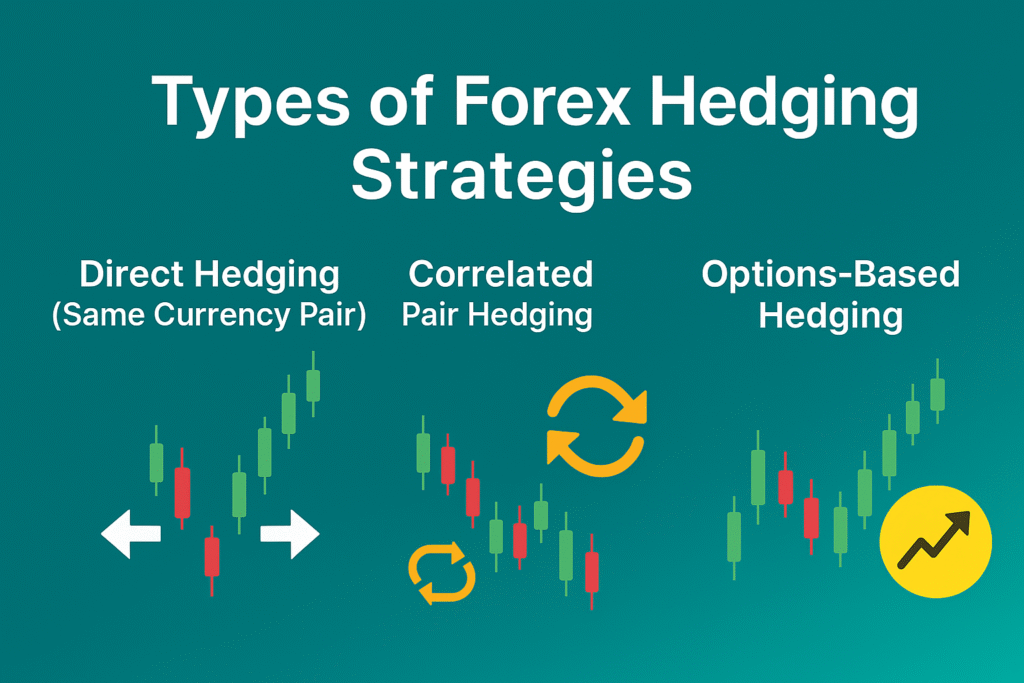
There are several ways to hedge in Forex trading. Let’s look at the three most popular methods used by traders and Expert Advisors.
🥇 1. Direct Hedging (Same Currency Pair)
This is the simplest form of Forex Hedging and perfect for beginners. It involves opening two opposite trades on the same currency pair at the same time.
Example:
You’re long (buy) on EUR/USD, but you think the price might drop soon. You open a short (sell) position for the same pair.
- If the price falls — your short earns profit while your long loses.
- If the price rises — your long gains more profit.
🥈 2. Correlated Pair Hedging
This method uses two related currency pairs that move in the same or opposite directions.
Example:
Buy EUR/USD and Sell GBP/USD. Both pairs often move similarly since they share the U.S. dollar.
If the Euro weakens faster, your short GBP/USD trade helps offset some loss from EUR/USD.
Why It Works:
It provides partial protection while allowing flexibility to profit from different pair behaviors.
🥉 3. Options-Based Hedging
This is a professional-level strategy where traders use Forex options — contracts that give them the right (but not the obligation) to buy or sell a currency at a specific price.
Example:
You buy EUR/USD at 1.1000 but fear a drop. You purchase a put option allowing you to sell it at 1.0950.
If the Euro drops below 1.0950, your option gains value and offsets your loss.
💰 Benefits of Forex Hedging
Hedging is one of the smartest ways to reduce trading stress and preserve capital.
✅ 1. Risk Reduction
The main goal of Forex hedging is to minimize risk. When the market moves suddenly due to economic news, political changes, or unexpected events — hedging helps protect your funds. Instead of suffering a large loss, your hedge trade balances it by gaining in the opposite direction. This means your overall account remains safer and more stable, allowing you to stay in the market longer.
✅ 2. Profit Protection
Hedging isn’t just for losses it can also protect unrealized profits. If one of your trades is already in profit but you fear a short-term reversal, hedging locks in that profit temporarily. You can open an opposite position to secure gains while still staying in the trade.
✅ 3. Emotional Stability
Trading can be stressful especially when the market moves fast. Hedging helps remove the emotional pressure from your decisions because you know your trades are protected. When your risk is under control, you’re less likely to panic-sell or make impulsive choices.
This leads to better discipline, clearer analysis, and more consistent results in the long term.
✅ 4. Flexibility Across Trading Styles
One of the biggest advantages of hedging is its flexibility. It works across different timeframes and trading styles — whether you’re: You can easily adjust your hedge size and duration to suit your strategy. This adaptability makes hedging a valuable skill for all types of traders.
✅ 5. Automation Through Expert Advisors (EAs)
Thanks to modern trading platforms like MetaTrader 4 (MT4) and MetaTrader 5 (MT5), hedging can now be fully automated using Expert Advisors (EAs).This automation saves time, reduces human error, and allows traders to manage multiple positions more efficiently.
⚠️ Drawbacks & Limitations of Forex Hedging
While hedging is useful, it’s not perfect. Here are a few downsides you should know:
❌ 1. Reduced Profit Potential
When one trade offsets another, your net profit is usually smaller.
❌ 2. Higher Costs
Hedging involves multiple open positions — meaning more spreads, swaps, and commissions.
❌ 3. Complexity
Some strategies (like correlated or options hedging) require deep understanding of the market.
❌ 4. Broker Restrictions
Certain brokers (especially U.S.-based under FIFO rules) don’t allow direct hedging.
Tip: Always confirm with your broker before using hedging EAs.
📅 When to Use Forex Hedging
You shouldn’t hedge all the time. The best traders use it strategically during high-risk periods.
📊 Ideal Times to Hedge:
- Before major news events (like NFP, interest rate decisions, or elections).
- During uncertain trends or sideways markets.
- To protect long-term positions from short-term pullbacks.
- When managing a multi-pair Forex portfolio.
⚡ Common Mistakes to Avoid
Even good traders make mistakes with hedging. Avoid these to stay ahead:
- Over-Hedging:
Too many opposite trades cancel each other and waste margin. - Ignoring EA Settings:
Improper configuration of your Expert Advisor can cause overtrading or incorrect lot sizes. - Hedging Without Purpose:
Every hedge should have a clear goal — protection, not confusion. - Ignoring Correlations:
Sometimes currency relationships change during high volatility. - No Exit Plan:
Always know when to close your hedge once the risk period is over.
❓ FAQs – Forex Hedging Strategies
Q1: Is Forex Hedging legal?
✅ Yes, hedging is legal worldwide, but some U.S. brokers restrict it due to FIFO rules.
Q2: Can I make profits only with hedging?
❌ No. Hedging is for risk control, not for direct profit-making.
Q3: Can I automate hedging using Expert Advisors?
✅ Absolutely! Many MT4/MT5 EAs can automatically open, manage, and close hedged positions.
Q4: Is hedging good for small accounts?
✅ Yes, but use smaller lot sizes and tight risk management to avoid margin pressure.
Q5: What is the safest hedging method?
✅ Direct hedging on the same currency pair is the easiest and safest for beginners.
🏁 Final Thoughts

At its core, Forex Hedging is about protection, not prediction. It’s not a tool to guarantee profits — instead, it helps traders stay safe, stable, and consistent even when the market becomes unpredictable.
By learning and applying different hedging techniques — such as direct, correlated, and options-based strategies — traders can manage risk more effectively. When these methods are combined with Expert Advisors (EAs), the process becomes faster, smarter, and more controlled.
In short, hedging allows traders to protect their capital, trade with confidence, and avoid emotional decisions. It’s not just about winning trades — it’s about surviving long enough to keep growing as a trader.
Sources
https://en.wikipedia.org/wiki/Hedge_(finance)



No Comments