
- Home
- Forex Tutorial
- 5 Smart Forex Tips: With or Wi ...

🔹 Introduction
In the world of Forex trading, success isn’t just about predicting market direction — it’s about managing risk and position size. We will tell you about 5 Smart Forex Tips That’s where the Martingale and No-Martingale (or flat-lot) methods come in. These two powerful trading approaches can shape how fast you recover losses, how consistent your profits are, and how stable your emotions remain while trading.
In this blog, we’ll explore
- What the Martingale and No-Martingale strategies areHow they work in Forex trading
- Their types, benefits, and drawbacks
- When to use each strategy
- Common mistakes traders make
- Plus, 5 expert tips to profit safely with or without Martingale
Let’s dive in 👇
⚙️ What Is the Martingale Strategy in Forex?
The Martingale strategy is a position-sizing technique that increases trade size after every losing trade. The idea is simple: when you eventually win, that one winning trade will recover all previous losses and add a small profit. In theory, this sounds like a foolproof way to recover — but in practice, it’s a high-risk, high-reward approach that requires careful management.
🧩 How It Works: Step-by-Step Example
Let’s make it simple.
Suppose you start trading EUR/USD with 0.01 lots:
- Trade 1 loses → Next trade becomes 0.02 lots
- Trade 2 loses → Next trade becomes 0.04 lots
- Trade 3 wins → The profit covers all past losses + a small extra gain
| Trade # | Lot Size | P/L ($) | Total P/L ($) |
|---|---|---|---|
| 1 | 0.01 | -10 | -10 |
| 2 | 0.02 | -20 | -30 |
| 3 | 0.04 | +40 | +10 |
While this looks appealing, it assumes unlimited capital — something most traders don’t have. In reality, equity limits, broker margin requirements, and long losing streaks make Martingale risky if not capped.
📘 What Is the No-Martingale (Flat Lot) Strategy?
The No-Martingale or Flat Lot strategy is the opposite approach. Here, you trade the same position size every time — no doubling, no compounding. Each trade risks the same amount, which makes it predictable and easier to manage emotionally.
💡 In simple terms:
You trade the same lot size (for example, 0.02 lots) every time, whether you win or lose.
If you lose $20 five times in a row, you’ll need five $20 wins to recover — slow but steady.
This strategy is safer, has a lower risk of ruin, and is ideal for new Forex traders learning to control emotions and build discipline.
🔄 How Each System Works in Practice
| Feature | Martingale | No-Martingale |
|---|---|---|
| Position Size | Doubles after each loss | Fixed each trade |
| Drawdown Recovery | Fast, but risky | Slow, steady recovery |
| Risk of Ruin | High | Low to moderate |
| Capital Requirement | Large | Small to medium |
| Psychological Impact | Stressful | Stable and consistent |
👉 Bottom Line
Martingale works best in sideways markets with small fluctuations, while No-Martingale shines in trending markets where patience and consistency pay off.
🧠 Types of Martingale and No-Martingale Strategies
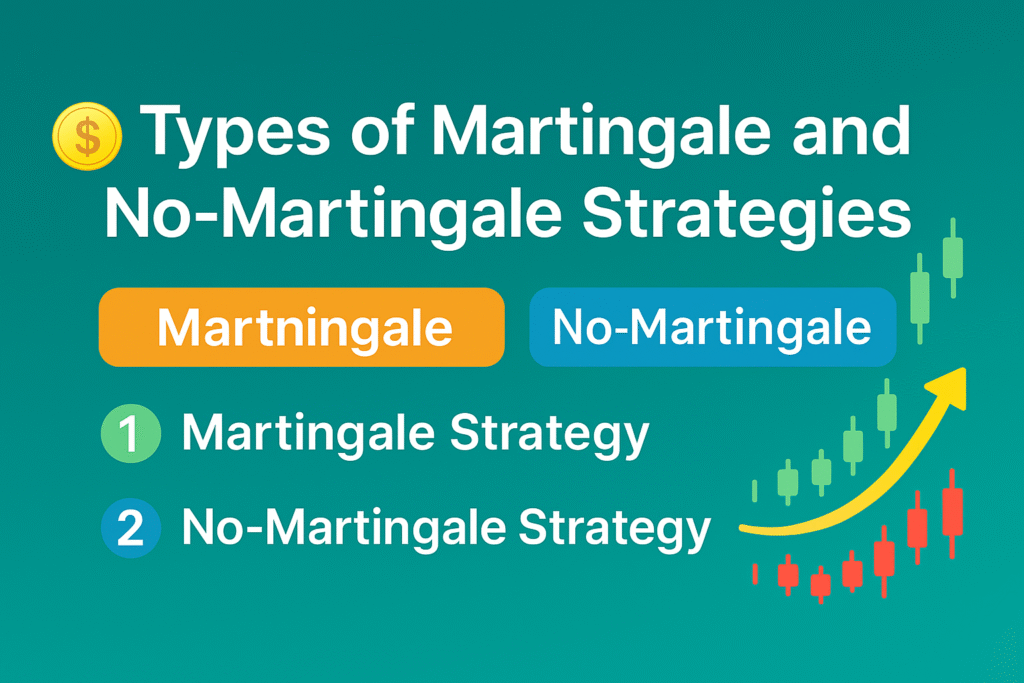
🟩 1. Classic Martingale
The traditional version where the lot size doubles after every loss until a winning trade occurs.
Best For: Range-bound pairs like EUR/CHF or AUD/NZD.
🟨 2. Anti-Martingale (Reverse Martingale)
Instead of increasing size after a loss, you increase it after a win — compounding profits while protecting capital during losing streaks.
Best For: Trend-following systems.
🟦 3. Flat (No-Martingale) Trading
This is the standard fixed-lot method. The position size stays the same no matter what happens.
Best For: Risk-controlled systems, prop firm challenges (like FTMO), and long-term consistency.
🟥 4. Hybrid Systems
Combines both ideas — a limited number of Martingale steps (usually 2–3) followed by flat-lot trading.
Best For: Automated Expert Advisors (EAs) that balance aggression with risk control.
💰 Benefits of Each Approach
Both methods can work well — it depends on your risk tolerance, trading capital, and strategy.
✅ Martingale Benefits
- Fast recovery after short losing streaks
- Simple, mechanical logic (easy to automate)
- Performs well in tight-range conditions
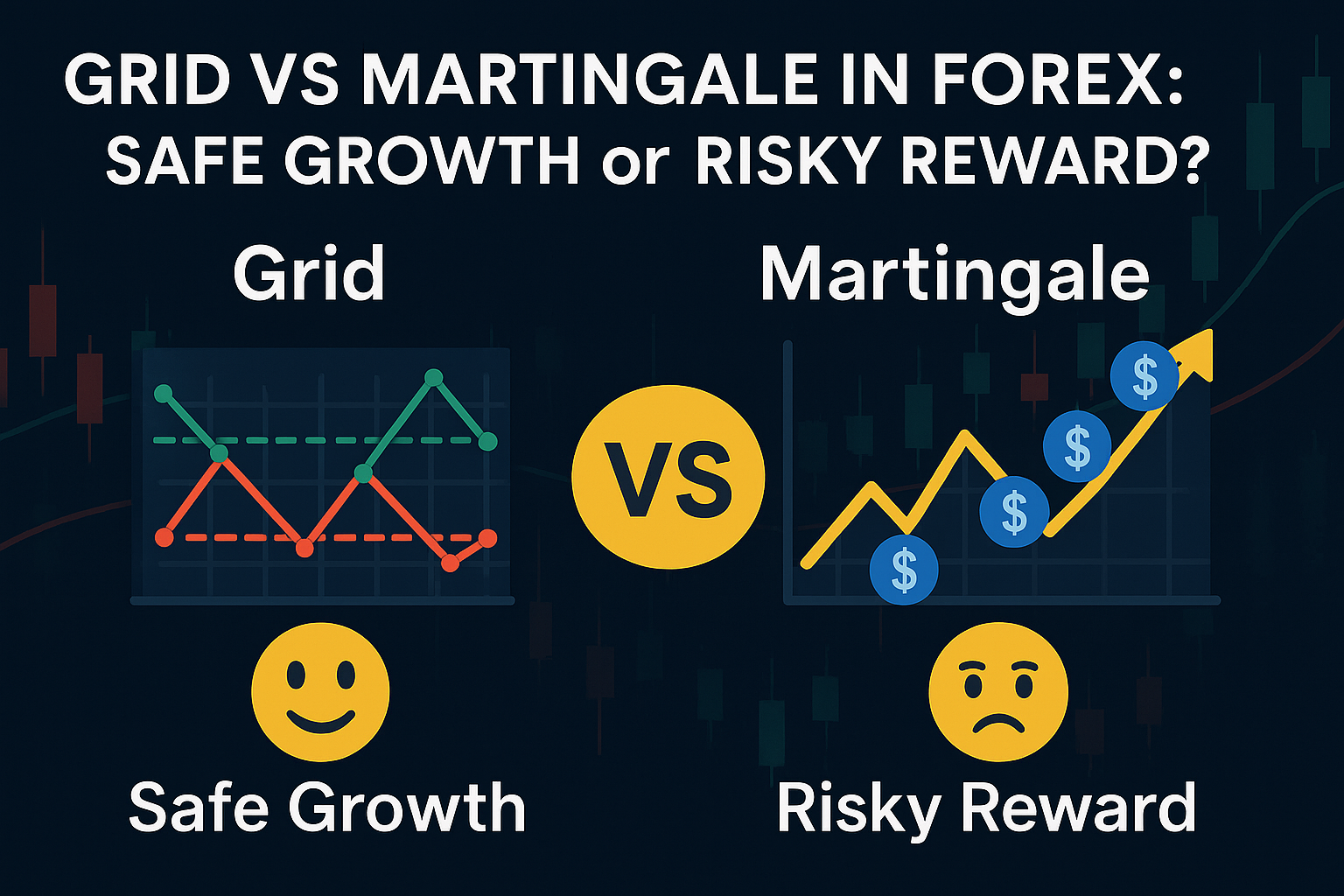
- Can be integrated into Grid Trading EAs for steady profit flow
✅ No-Martingale Benefits
- Predictable and consistent risk per trade
- Easier to manage psychologically
- Reduces chance of large drawdowns
- Approved by most prop firms and brokers
- Ideal for beginner Forex traders learning position sizing
⚠️ Drawbacks and Limitations
No Forex trading strategy is flawless — every approach has its own challenges. Whether you use Martingale or No-Martingale, it’s crucial to understand the potential downsides before applying them in real trading. Here’s what to be aware of 👇
⚠️ Martingale Limitations
The Martingale strategy may seem powerful, but it carries significant risks that can quickly spiral out of control if not managed carefully.
- High drawdown potential: During long losing streaks, losses can compound rapidly, creating massive pressure on your account balance.
- Requires large capital: Because lot sizes increase after every loss, this approach demands deep pockets and higher margin availability.
- Broker restrictions: Some brokers have limits on maximum lot sizes or leverage, which can break your Martingale progression mid-sequence.
- Psychological stress: Watching positions grow larger and losses pile up can be mentally draining, often leading to emotional decisions and early exits.
⚠️ No-Martingale Limitations
The No-Martingale (flat-lot) approach is much safer, but it isn’t perfect either. While it keeps risk predictable, it can feel slow and less rewarding during short-term trades.
- Slower recovery: Because trade sizes remain constant, recovering from a drawdown takes longer and requires more winning trades.
- Lower short-term profits: Fixed lot sizing limits your potential gains during favorable market phases.
- Lack of excitement: For aggressive traders, the steady pace of flat trading can feel monotonous or “too safe.”
- May lag in volatility: When the market moves sharply, this method may underperform compared to more adaptive or dynamic systems.
📅 When to Use Each Strategy
Choosing between Martingale and No-Martingale depends on market behavior and account type:
| Market Condition | Recommended Strategy |
|---|---|
| Ranging / Sideways Market | Martingale or Hybrid |
| Trending Market | No-Martingale |
| High Volatility (News Events) | Flat or capped Martingale |
| Small Accounts | Flat or Anti-Martingale |
| Automated EAs | Limited Martingale Grid |
💡 Transition Thought
Understanding when to apply each approach helps you trade smarter, not harder. Next, let’s look at the most common mistakes traders make.
❌ Common Mistakes to Avoid
Even though both methods can work, traders often misuse them. Avoid these key errors 👇
- Unlimited Doubling: Never keep increasing forever — limit Martingale steps to 3–4 maximum.
- Ignoring Risk Limits: Always define an equity stop-loss (e.g., 8–10%).
- Using Martingale During Volatility: High volatility (like NFP or CPI) can wipe your account fast.
- Overconfidence: Believing Martingale “always recovers” leads to margin calls.
- Skipping Backtesting: Test your setup with realistic spreads, swaps, and slippage before going live.
🧩 5 Expert Tips to Profit Safely (With or Without Martingale)
Here are five practical tips to help you manage both methods like a pro:
1️⃣ Cap Your Martingale Steps
Always keep your Martingale sequence limited and under control. Extending it endlessly multiplies risk faster than you can recover. When you cap your progression, you maintain stability and prevent one bad streak from destroying your account balance. It’s about discipline — not endless doubling.
2️⃣ Use an Equity Stop-Loss
Every trader needs a hard limit that says “enough.” Setting a clear equity stop-loss creates a protective barrier for your capital. When your equity reaches that point, the system stops trading automatically, ensuring you live to trade another day.
3️⃣ Add Volatility Filters
Trading without monitoring volatility is like driving blind in a storm. Volatility filters act as your radar, helping you avoid unpredictable market spikes that can break any strategy — Martingale or not. By respecting calm and stable conditions, your trades align better with market rhythm and consistency.
4️⃣ Diversify Strategies
No single system wins in every condition. Diversification spreads your risk, smooths your equity curve, and creates balance between aggression and caution. Combining multiple trading logics ensures that when one approach slows down, another steps up giving you long-term growth and resilience in the market.
5️⃣ Backtest Realistically
Backtesting isn’t just a checkbox; it’s your truth test. It reveals how your system behaves in stress, uncertainty, and time. Realistic backtesting exposes weaknesses before real money is at stake, helping you refine your methods and build a system capable of surviving real-world pressure. It’s the difference between guessing and knowing.
❓ FAQs – Martingale vs No-Martingale
Q1: Can Martingale be profitable long-term?
✅ Yes, but only with strict risk management and capped exposure. Without limits, it becomes dangerous.
Q2: Which method is better for beginners?
✅ The No-Martingale approach is safer and easier for small accounts. Martingale suits experienced traders with large capital.
Q3: Is Martingale allowed by brokers?
✅ Usually yes, but some prop firms and competitions restrict it. Always check your broker’s terms.
Q4: Can Martingale be automated?
✅ Absolutely! Many MT4/MT5 EAs use Martingale or hybrid logic — just make sure they include equity protection.
Q5: What market is best for Martingale?
✅ Range-bound, low-volatility markets like EUR/CHF or AUD/NZD are ideal since price swings are smaller and more predictable.
🏁 Final Thoughts

At the end of the day, both Martingale and No-Martingale strategies can be profitable — if used wisely.
The Martingale strategy offers faster recovery and higher short-term gains but demands strict discipline and sufficient capital.
The No-Martingale approach prioritise stability, slow growth, and emotional control, making it perfect for new traders and prop challenges.
The smartest traders don’t rely on just one system they adapt both methods based on market conditions and account size. So whether you’re an aggressive risk-taker or a cautious strategist, focus on managing exposure, automating with Expert Advisors (EAs), and letting data — not emotion guide your decisions.
Trade wisely, protect your capital, and let your strategy grow with you.
Sources
https://en.wikipedia.org/wiki/Martingale_(betting_system)



No Comments