
- Home
- EA Reviews
- Impressive Zafiro pro EA Resul ...

✨ Introduction
In this blog, we will dive into a detailed performance review of the Zafiro pro EA, an automated gold-trading system designed for precision, swing-based entries. To help traders and learners understand how this EA behaves under different capital conditions, we will compare its results on both a $500 account and a $1,000 account.
Our aim is to present this information in a simple, educational format so beginners can clearly see how account size impacts profitability, drawdown levels, and overall trading stability when using expert advisors.
Throughout this blog, we will discuss
- 📌 How the Zafiro EA works and what trading logic it uses
- 📊 Backtest results on $500 and $1,000 accounts
- ⚖️ Comparison of performance, growth, and risk exposure
- 💡 Strengths and weaknesses of this EA
- 🎯 When this EA approach may be suitable for traders
- 🧠 Key lessons for Forex learners and automation users
By the end of this review, you will have a clear understanding of how the Zafiro pro EAmanages risk, handles account equity, and performs under real-market simulation — giving you better insight into evaluating EAs responsibly and with proper expectations.
💡 Zafiro Pro EA Backtest Review – $500 Account Performance
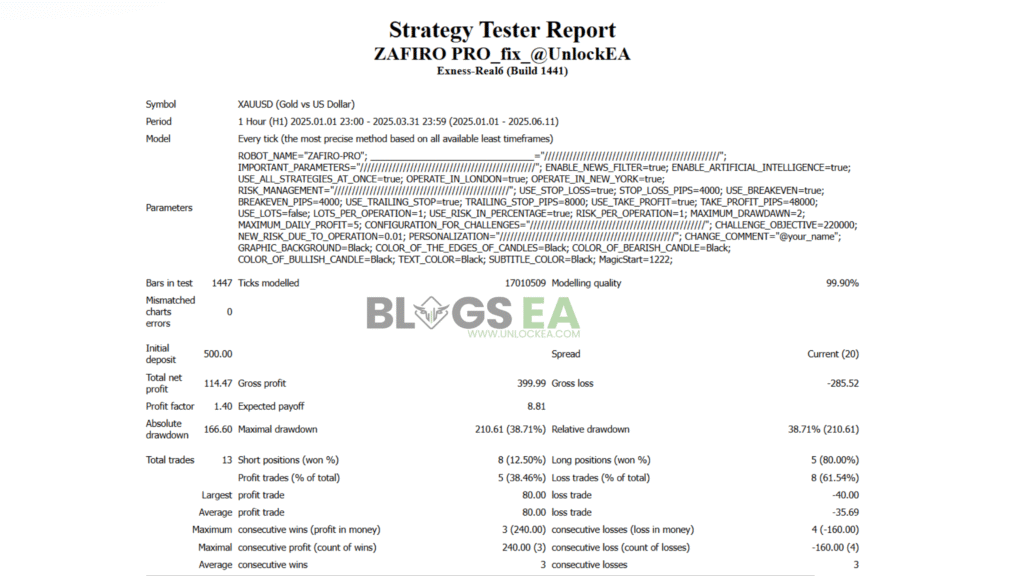
The Zafiro pro EA was tested on XAUUSD (Gold) using the H1 timeframe under Exness-Real6 with 99.90% modeling quality, ensuring highly accurate simulation results. This backtest ran from January 1, 2025, to March 31, 2025, and started with a $500 deposit, giving us a realistic picture of how this EA behaves on small capital.
During the three-month test period, the EA generated a total net profit of $114.47, turning the starting balance into $614.47 by the end of March Zafiro 500. While the monetary gain may seem modest, this represents 22.89% growth in a quarter — a respectable return for a conservative strategy.
However, profitability is only one side of the story. The Zafiro EA experienced significant drawdown, reaching a maximum drawdown of $210.61, equal to 38.71% of the account Zafiro 500. This means the system risked a large portion of capital at certain points, making it more aggressive than the profit alone initially suggests.
In total, the EA executed 13 trades throughout the whole period — a very low trading frequency compared to typical gold EAs Zafiro 500. Out of these trades, only 5 closed in profit, while 8 resulted in losses, giving the EA a 38.46% win rate Zafiro 500. Interestingly, despite more losing trades than winning ones, the EA still finished positive. This was possible because winning trades were much larger, with the biggest profit trade at $80 and the largest loss at $40 Zafiro 500.
On average, each profitable trade earned $80, while each losing trade averaged –$35.69 Zafiro 500. The system clearly focused on larger-target gold moves, aiming to catch big swings rather than scalp small pips. The EA’s max consecutive wins were 3, producing $240 profit, while the longest losing streak was 4 trades, costing –$160 Zafiro 500.
This behavior suggests the EA takes trades based on strong directional signals and holds them for big take-profit levels. But with stop-losses also at wide distances, losing streaks can be significant.
The EA settings confirm this: it used a fixed 1% risk per trade, stop loss of 4000 pips, and take profit of 48000 pips — extremely wide levels meant for long-term trend catching. It also operated during London and New York sessions, with AI and multi-strategy mode enabled
💹 Zafiro Pro EA Backtest Review — $1,000 Account Performance
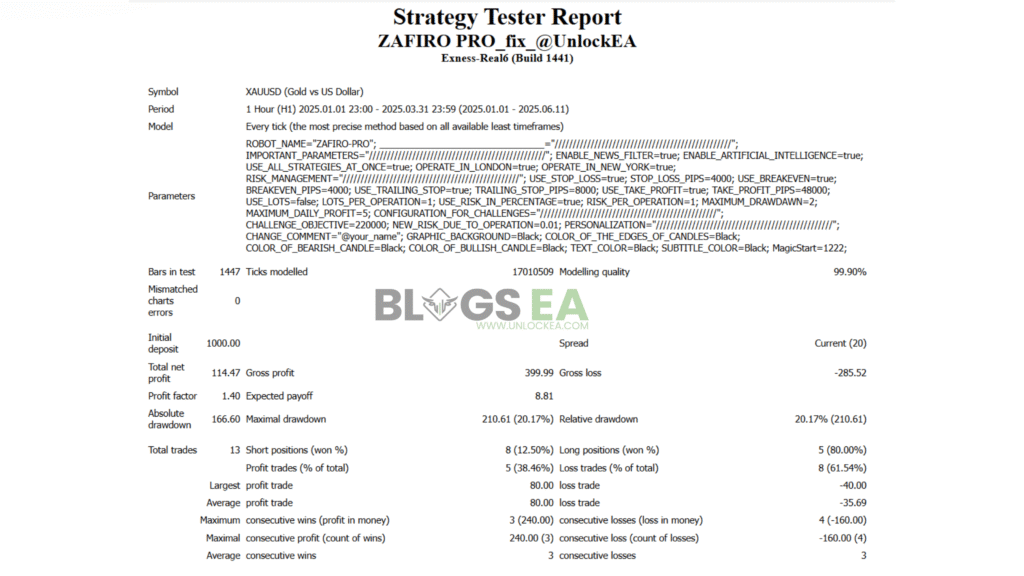
The Zafiro Pro EA was tested on XAUUSD (Gold) using the H1 timeframe under the Exness-Real6 server with 99.90% modelling quality, ensuring a highly reliable and precise test environment. The backtest covered the period from January 1, 2025, to March 31, 2025, beginning with a $1,000 initial deposit.
At the end of the three-month period, the EA produced a net profit of $114.47, closing with a total balance of $1,114.47 Zafiro 1000. While the monetary return is relatively small, it represents around 11.4% growth, consistent with controlled-risk trading rather than high-frequency or aggressive capital expansion.
The EA executed 13 total trades, the same as in the $500 test, confirming that the strategy follows strict selective entry criteria Zafiro 1000. Out of these trades, 5 were profitable and 8 ended in losses, resulting in a 38.46% win rate — again matching the $500 test exactly Zafiro 1000. Despite more losing trades than winners, the system remained profitable due to its larger-reward-than-risk structure — a key part of the strategy.
The largest winning trade generated $80, while the largest losing trade amounted to -$40 Zafiro 1000. Average winning trades also earned $80, compared to -$35.69 average loss Zafiro 1000, reinforcing that the EA uses large take-profit levels and wide stop-losses.
📊 Risk & Drawdown Behavior
The Zafiro EA experienced an absolute drawdown of $166.60 and a maximum drawdown of $210.61, which equals 20.17% of the account Zafiro 1000. This is significantly lower than the 38.71% drawdown seen on the $500 account test, confirming that the EA stabilizes better with more capital while running the same settings.
The trading pattern also shows maximum consecutive wins of 3 trades, producing $240 profit, while the largest losing streak was 4 losses in a row costing –$160 Zafiro 1000. This consistency again matches the small-account backtest behavior — demonstrating a clear, repeatable trading logic.
🧠 Trading Style Insights
The Zafiro EA clearly focuses on trend-based swing entries on gold, capturing sizable market moves when momentum aligns. It utilizes:
- AI-assisted logic
- Multi-strategy entry rules
- Wide stop loss & take-profit levels
- Breakeven & trailing systems
- Low-frequency, high-reward execution
This EA avoids frequent scalping or grid trading — instead, it patiently waits for high-probability trend shifts. That patience translates into few trades but large profit targets, which can benefit traders looking for minimal screen time and clean trade logic.
📊 Zafiro Pro EA Backtest Comparison — $500 vs $1,000 Account
| Metric | $500 Account | $1,000 Account |
|---|---|---|
| Initial Deposit | $500 | $1,000 |
| Final Balance | $614.47 | $1,114.47 |
| Net Profit | $114.47 | $114.47 |
| % Return | 22.89% | 11.44% |
| Total Trades | 13 | 13 |
| Win Rate | 38.46% | 38.46% |
| Profit Factor | Not shown | Not shown |
| Largest Profit | $80 | $80 |
| Largest Loss | –$40 | –$40 |
| Average Profit | $80 | $80 |
| Average Loss | –$35.69 | –$35.69 |
| Max Consecutive Wins | 3 | 3 |
| Max Consecutive Losses | 4 | 4 |
| Max Drawdown | $210.61 (38.71%) | $210.61 (20.17%) |
| Trading Style | Low frequency, swing strategy | Low frequency, swing strategy |
💪 Strengths of theZafiro pro EA
One of the most notable strengths of the Zafiro EA is its high reward-to-risk trading logic, allowing it to stay profitable even with a lower win rate. Instead of relying on frequent scalping trades, the EA focuses on quality over quantity, entering only when high-probability market conditions align. This selective entry approach reduces unnecessary market exposure and avoids over-trading. Another strong point is the EA’s trend-following strategy, which aims to capture meaningful swings in gold rather than chasing small, volatile movements.
These larger-target trades give the EA the potential to generate solid gains when market momentum is in its favor. Additionally, the Zafiro EA performs more efficiently with higher capital, demonstrating increased stability and reduced drawdown as account size grows. For traders who appreciate patience, discipline, and long-term structure, this EA can be a valuable tool and a practical learning model for swing trading automation.
⚠️ Weaknesses of the Zafiro pro EA
While the Zafiro EA does show profitable long-term potential, it also carries certain limitations that traders must be aware of. Its low trade frequency means users may see long periods without trades, which can be challenging for traders who expect constant activity. This slow-paced approach requires patient trading psychology, especially during market consolidation phases.
The system also experiences deep drawdown cycles, particularly on smaller account balances, where recovery periods may feel uncomfortable for new traders or those with low risk tolerance. In prop-firm environments with strict daily and maximum drawdown rules, this default behavior could be risky without proper optimization or reduced risk settings. Additionally, the EA relies heavily on larger stop-loss and take-profit distances, which means holding trades for longer periods and enduring price fluctuations before hitting targets. This strategy may not suit traders who prefer fast exits or lower exposure times. Overall, while the Zafiro EA is effective in the right conditions, it demands emotional discipline, proper capital allocation, and realistic expectations.
🧾 Final Thoughts

The Zafiro Pro EA demonstrated consistent behavior across both account sizes, executing the same number of trades, maintaining the same win rate, and achieving equal monetary profit in both backtests. However, the performance dynamics shifted noticeably depending on capital size:
- On the $500 account, the EA delivered a stronger percentage return (22.89%), but experienced a much higher drawdown of 38.71%, meaning nearly half the capital was under pressure at certain points. This shows that when running on small balances, the EA’s strategy carries higher emotional stress and requires the ability to withstand substantial equity swings.
- On the $1,000 account, the EA achieved lower percentage growth (11.44%), but the drawdown dropped sharply to 20.17%, demonstrating improved stability and smoother trade handling. With more capital, the system absorbs volatility better and behaves more sustainably.
Despite a low 38.46% win rate, the EA still ended profitable due to its large reward-to-risk approach, proving that accuracy alone does not determine EA performance — risk-reward and trade logic matter equally.
Click the link below to get ZAFIRO PRO MT4 EA and start exploring its powerful backtesting performance.
https://unlockea.com/product/zafiro-pro-mt4-ea


No Comments