
- Home
- Forex Tutorial
- Master Trend Following: Trade ...


✅ Introduction
Have you ever looked at a strong market trend and thought, “If only I had entered earlier, I could’ve made huge profits?” That’s the power of trend-following — a trading approach designed to capture major market moves instead of fighting against them.
Trend following matters because most successful long-term traders don’t guess where the market will turn — they follow the direction of price, manage risk, and let profits run. It simplifies trading psychology, reduces emotional bias, and helps traders stay aligned with market momentum instead of battling it.
In this blog, we will cover
- What trend-following means in forex
- How trend-following works with a real example
- Major types of trend-following strategies
- Key benefits of following trends
- Limitations & risks
- When to apply trend-following
- Common trader mistakes
- Frequently asked questions
- Professional final insights for disciplined traders
By the end, you’ll understand how to identify trends, trade with confidence, and avoid emotional counter-trend traps.
✅ Simple Explanation
A trend following strategy is a forex trading method where traders identify and follow the existing market direction buying during strong uptrends and selling or shorting during strong downtrends. Instead of predicting market tops or bottoms, trend followers wait for price confirmation, enter in the direction of momentum, and remain in the trade until signs of trend reversal appear.
Common tools include moving averages, trendlines, breakout levels, price channels, and momentum indicators. The core principle is simple:
Trade in the direction of the trend — not against it.
✅ How It Works (With Example)
Imagine the EUR/USD chart shows a consistent uptrend. Price remains above the 50-period moving average, forming higher highs and higher lows. A bullish breakout occurs above a previous resistance level at 1.0950.
A trend-follower would:
✅ Enter a long trade after price breaks above 1.0950
✅ Place a stop-loss below the prior swing low (for safety)
✅ Hold the position as long as price stays above the moving average
✅ Exit only when price breaks below support or signals reversal
Rather than chasing tops or guessing reversals, the trader rides the wave and lets profitable trades run. This approach turns big market moves into big profit opportunities.
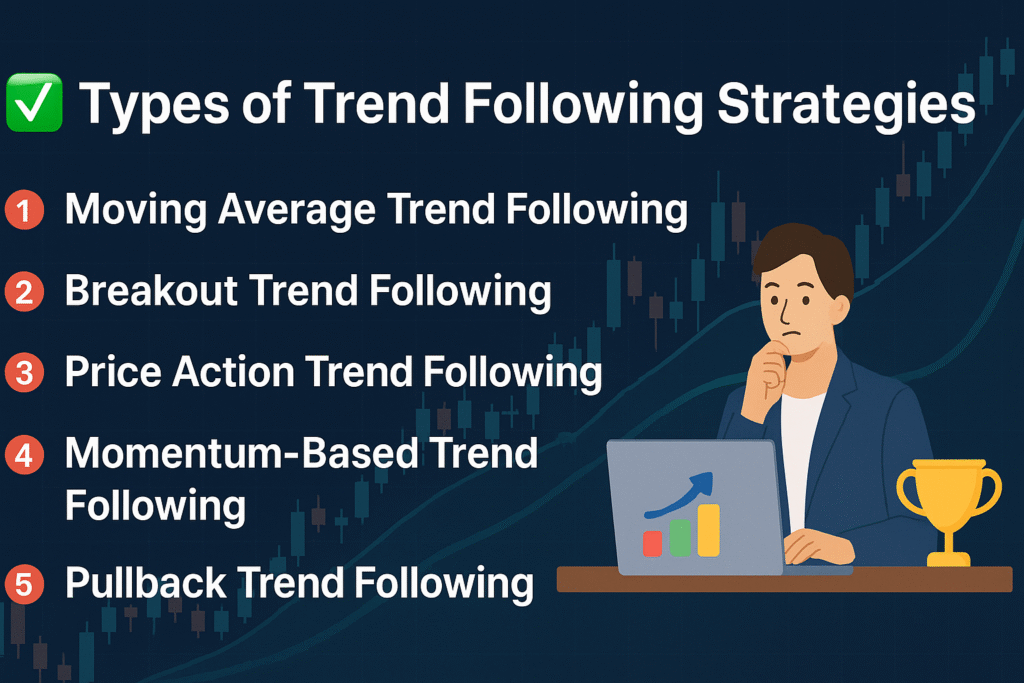
✅ Types of Trend Following Strategies
1️⃣ Moving Average Trend Following
This method uses moving averages such as SMA or EMA to identify the trend direction and generate entries. Traders often look for crossover signals — for example, when the 50 EMA crosses above the 200 EMA, known as a Golden Cross. This crossover suggests momentum shifting to the upside and signals potential buying opportunities.
2️⃣ Breakout Trend Following
Breakout traders focus on price breaking through key levels, such as support and resistance areas, consolidation zones, or trendline barriers. A breakout signals that the market has gathered enough strength to push into a new trend phase. Once price escapes a range with strong momentum, traders enter in the direction of the breakout and follow the new trend.
3️⃣ Price Action Trend Following
This approach relies on raw price movement rather than indicators. Traders analyze higher highs, higher lows, trendline breaks, candlestick signals, and structure shifts to confirm the trend. By focusing directly on market behavior, price-action traders aim to follow trends without lagging tools, relying purely on market structure and candle patterns.
4️⃣ Momentum-Based Trend Following
Momentum trend-followers combine trend direction with strength indicators such as RSI, ADX, MACD, or Stochastic. The idea is to enter only when the trend is not just present but strong. By confirming momentum, traders enhance confidence that the trend has solid backing before committing to positions.
5️⃣ Pullback Trend Following
Pullback traders wait for price to temporarily retrace against the trend and then enter when the trend resumes. Common tools include moving averages, Fibonacci levels, and support/resistance retests. This method aims for safer entries with tighter stop-loss levels and more favorable risk-to-reward opportunities.
✅ Benefits of Trend Following Strategy
Ride Big Market Moves
Trend-following allows traders to catch large price swings that can continue for hours, days, or even months. By staying with the dominant direction, traders position themselves to benefit from extended market momentum rather than short-lived fluctuations.
Simple & Clear Rules
The strategy is straightforward and easy to understand, especially for beginners. Since the main focus is following price direction, decisions become simpler — making it easier to stick to a plan instead of constantly guessing market turns.
Reduces Emotional Trading
Trend-following encourages traders to rely on structure and logic rather than emotion. This reduces fear, overthinking, and impulsive decisions, helping traders maintain discipline and stay calm during market movement.
Works in All Markets
This approach is versatile and effective across forex, stocks, commodities, and crypto. Trends exist in every market, making trend-following a universal trading method that adapts to various assets and environments.
Strong Risk-to-Reward Potential
With proper entries and risk control, one strong trend can produce returns that outweigh multiple smaller losing trades. Trend-followers can achieve powerful growth by letting winners run while cutting losing trades quickly.
✅ Drawbacks / Limitations
❌ Whipsaws in Ranging Markets
Trend following struggles when the market moves sideways. In choppy or ranging conditions, price fails to maintain direction, leading to false signals, repeated stop-outs, and market noise that can quickly erode profits.
❌ Requires Discipline & Patience
This strategy demands patience, as traders must wait for clear, confirmed setups instead of reacting impulsively. Those who cannot resist the urge to enter early or frequently may struggle, since discipline is essential for consistent success.
❌ Late Entries & Exits
Trend following indicators typically confirm trends only after they begin, meaning traders may enter later than ideal. Similarly, exits may be delayed, sometimes giving back a portion of profits before the signal closes the trade.
❌ Emotional Challenge During Pullbacks
Even strong trends have pullbacks, and watching price move against an open position can be psychologically challenging. Traders must remain calm and trust their plan rather than panic during temporary retracements.
✅ When to Use Trend Following
Trend following shines when the market isn’t just moving — it’s sprinting like it stole something. If price is charging in one direction with the confidence of a marathon runner who already spotted the finish line, that’s your moment. Strong news backing the trend? Even better — think of it as the universe saying, “Yes, go with the flow.” During peak sessions like London and New York, when markets are alive, caffeinated, and full of volume, trend-following becomes a smooth ride. And when major pairs like EUR/USD or GOLD are trending hard? Strap in — you’re basically surfing a financial tsunami.
❌ When to Avoid Trend Following
Trend-following becomes torture when the market is moving sideways like it’s half asleep and just can’t be bothered. If the chart looks like a flat heart monitor, run. Low liquidity sessions? Spreads widen like airport security queues before holidays — and they eat your profits alive. And if the market starts throwing dramatic reversal signals like a plot twist in a soap opera, don’t be a hero — step away before the trend flips and drags your trade into disaster.
✅ Common Mistakes Traders Make
❌ Jumping in Way Too Early
Trying to predict a trend before it actually exists is like running onto a stage before your name is called. The market will gladly smack your enthusiasm and take your money for being over-eager.
❌ Treating Stop-Loss Like an Optional Suggestion
Skipping a stop-loss is basically telling the market, “Go ahead, ruin me.” Trends can flip faster than your mood on Monday morning — protection isn’t optional, it’s survival.
❌ Over-trading & FOMO Clicking
Chasing every candle that twitches? Entering just because it “looks like it might go”? That’s not trading — that’s chaos with a trading platform. Calm fingers = calm account.
❌ Panicking During Pullbacks
Seeing a tiny pullback and exiting like the market is collapsing is how traders miss beautiful runs. Not every dip is a disaster — sometimes it’s just the trend catching its breath.
❌ No Trend Filter = Welcome to Whipsaw City
Trading a “trend” when the market is moving sideways like a sleepy snail will have you whipsawed into emotional exhaustion. Trend filters exist to save your sanity (and account).
✅Use of EA,s in Trend Following
Expert Advisors (EAs) can assist trend-followers by automatically identifying trend direction, placing trades, and managing exits based on pre-defined rules. They help remove emotional decision-making and ensure consistent execution, especially during extended market movements.
✅ FAQs Section
Q1: What timeframe is best for trend-following?
Trend-following works across timeframes, but H1, H4, and Daily charts provide cleaner trends.
Q2: Can beginners use trend-following?
Yes — it’s one of the easiest strategies for beginners because the direction guides decision-making.
Q3: Which indicators help identify trends?
EMA, SMA, ADX, RSI, MACD, trendlines, and price action patterns.
Q4: Do trend-following traders use stop-losses?
Absolutely — stop-losses protect against sudden reversals.
Q5: Does trend-following work on gold and crypto?
Yes — gold, Bitcoin, and major forex pairs all trend strongly.
✅ Final Thoughts

Trend following is a timeless strategy used by professional traders, hedge funds, and algorithmic systems worldwide. It rewards patience, discipline, and structure — not prediction or emotion. Instead of trying to catch tops and bottoms, you ride powerful waves with confidence and clarity.
For beginners, this strategy builds strong trading habits: follow price direction, respect risk, and allow profits to grow naturally. Before trading live, practice spotting trends, drawing trendlines, and combining indicators with price action.
Sources
https://en.wikipedia.org/wiki/Trend_following



No Comments