
- Home
- Forex Tutorial
- Trade Like a Pro: Master Harmo ...


✅ Introduction
Ever wished you could spot market reversals before they happen — like seeing the turning point forming while everyone else is still guessing? Harmonic trading feels like uncovering a secret map of the market, where patterns and Fibonacci ratios guide you to precision-based entries.
Master Harmonic Patterns strategy matters because harmonic patterns don’t rely on random guesswork — they use mathematics, market psychology, and geometry to forecast price turning points with structure and accuracy. It’s not magic — it’s disciplined pattern recognition rooted in decades of trading research.
In this blog, we will explore:
- What harmonic patterns are
- How harmonic trading works (with example)
- History & evolution of harmonic chart patterns
- Types of harmonic patterns
- Key benefits and limitations
- How to use harmonic patterns in forex trading
- Common mistakes and how to avoid them
- Frequently asked questions
- Final guidance for aspiring harmonic traders
Whether you’re new to forex or leveling up your chart skills, this guide will help you understand harmonic patterns from foundation to mastery — step-by-step.
✅ What Are Harmonic Patterns? (Simple Explanation)
Harmonic patterns are advanced chart patterns that use Fibonacci ratios to predict precise market reversal levels. They are built from geometric price movements and help traders enter at high-probability turning points.
In simple terms
Harmonic trading finds price patterns that repeat and uses Fibonacci levels to forecast where price will reverse.
These patterns are considered leading indicators — meaning they try to forecast future price turning
points before the market makes the move.
✅ What is Fibonacci
Fibonacci refers to a mathematical concept with two primary components: the Fibonacci sequence (a series of numbers) and the associated Fibonacci ratios, which converge to the golden ratio (approximately 1.618)
✅ How Harmonic Trading Works (With Example)
Imagine the market forms a five-point structure labeled X-A-B-C-D. As price moves, harmonic traders measure Fibonacci ratios between these points. If the ratios match a specific harmonic pattern — such as the Gartley or Bat pattern — the final point (D) becomes a Potential Reversal Zone (PRZ).
Example: Bullish Gartley Pattern (Simplified)
Price forms:
- XA upward leg
- AB retracement → ideally 61.8% of XA
- BC retracement → 38.2%-88.6% of AB
- CD extension → 78.6% retracement of XA
The final point D completes the pattern at the PRZ, where price is expected to reverse upward.
Trade Plan:
- BUY at Point D (PRZ)
- STOP-LOSS slightly below PRZ
- TARGETS at Fibonacci extensions (e.g., 38.2% or 61.8% of CD leg)
This method isn’t about guessing — it’s precision trading based on measured price swings and ratios.
✅ History & Development of Harmonic Patterns
📌 H.M. Gartley – The Origin (1930s)
H.M. Gartley was the forefather of harmonic trading, planting the seed in the 1930s like a genius decades ahead of his time. In Profits in the Stock Market (1935), his legendary “Gartley 222” pattern became the holy blueprint for market structure traders. What started as one pattern eventually evolved into an entire trading universe.
📌 Larry Pesavento & Bryce Gilmore
Pesavento and Gilmore didn’t just study Gartley — they supercharged the movement. They layered Fibonacci ratios into the patterns like precision engineering, refining them into something almost mathematical and mystical. Gilmore went further, unveiling new structures like the Butterfly pattern, expanding harmonic trading like explorers charting new continents.
📌 Scott Carney – Modern Harmonic Theory (1998+)
Scott Carney didn’t just join the harmonic world — he put a crown on it. He coined the term “Harmonic Patterns” and created icons like the Bat, Crab, and Shark patterns, bringing razor-sharp accuracy and rules to the method. Carney transformed harmonic trading into a complete scientific trading system, taking it from theory to global dominance. the concept of PRZ (Potential Reversal Zone) — now core to harmonic trading.
✅ Core Principles Behind Harmonic Trading
Fibonacci-Based Market Structure
Harmonic trading doesn’t just follow price — it follows the mathematical heartbeat of the universe. Markets breathe in retracements and exhale expansions using the same sacred Fibonacci ratios seen in seashell spirals and galaxies. When price turns at 0.618 or rockets from 1.618, it’s not coincidence — it’s nature meeting finance in pure mathematical rhythm.
Market Psychology Repeats
These patterns aren’t random lines — they’re the echo of human emotion, repeating over and over as fear and greed dance across the charts. Harmonics decode crowd behavior like reading the market’s subconscious. Traders panic, chase, hesitate, reverse — and harmonic patterns catch those emotional footprints with uncanny precision.
Precision Over Assumption
Harmonic patterns don’t accept sloppy guessing or “almost close” eyeballing. This strategy demands surgical precision, the kind used by master architects and chess grandmasters. Either the Fibonacci ratios align perfectly, or the pattern doesn’t exist. There’s no halfway — only high–accuracy setups built on discipline, not hope.
Leading Indicator Approach
While most traders react after the move, harmonic traders stand ready before the market even breathes. They forecast reversals like weather scientists predicting storms — not based on luck, but structure. Harmonics aim to spot turning points in advance, giving traders the power to enter before the herd sees what’s coming.
✅ Types of Harmonic Patterns
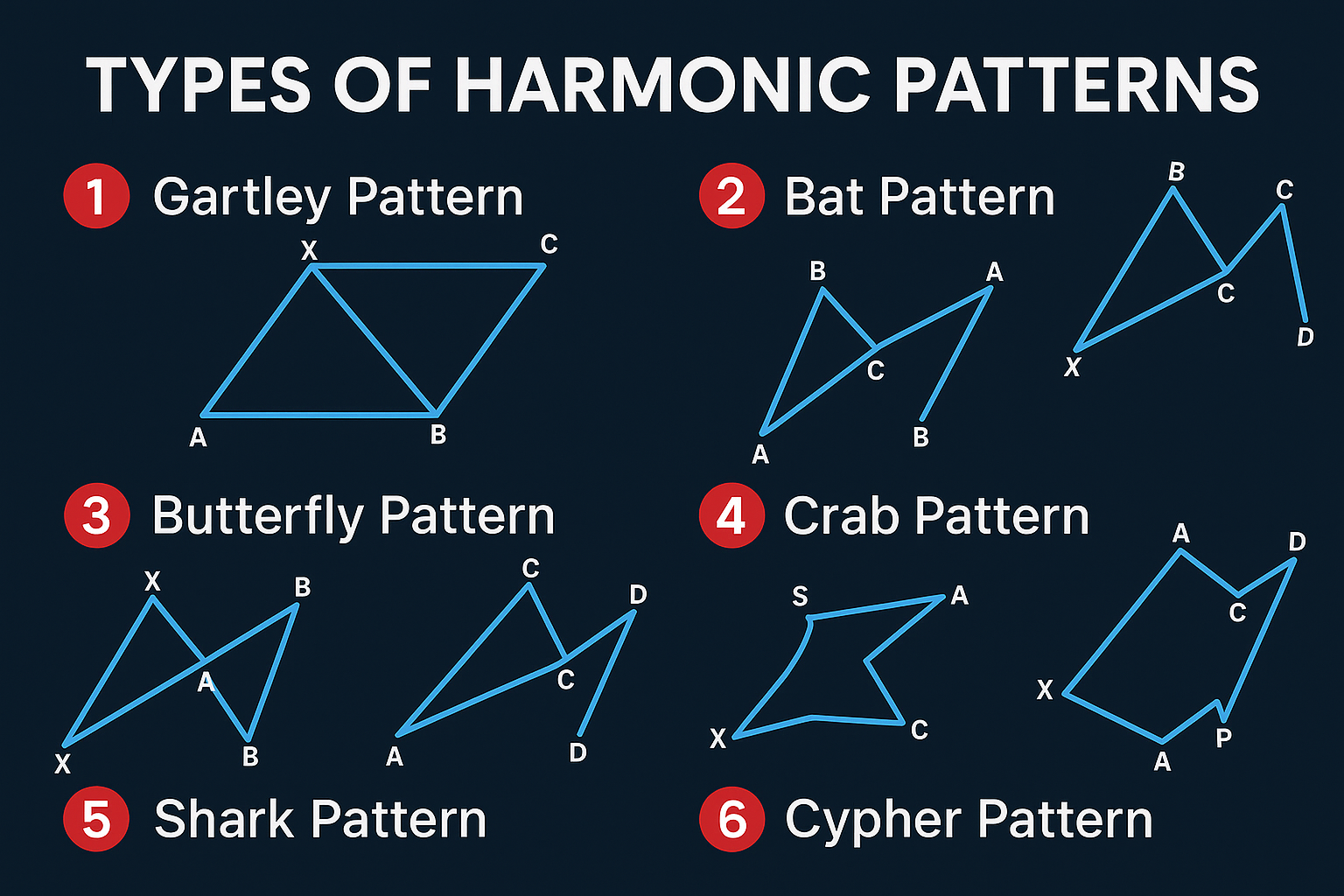
There are many harmonic patterns — each with unique Fibonacci rules. Here are the most traded ones:
1️⃣ Gartley Pattern
The legendary father of all harmonic patterns — the OG blueprint of market geometry. The Gartley doesn’t whisper signals… it hands you a map to continuation gold after a clean correction.
When this pattern forms, it’s like the market saying, “Ready? The trend isn’t done — jump back in.”
2️⃣ Bat Pattern
The Bat is the sniper of harmonic trading — patient, precise, deadly accurate. It dives deep into the retracement zone, tests trader discipline, and then launches a reversal so clean it feels scripted.
Shallow XA, perfect zone — when a Bat pattern hits, reversals don’t just happen, they snap into place.
3️⃣ Butterfly Pattern
The Butterfly arrives at the end of trends like a dramatic finale, announcing, “Show’s over — reversal incoming.” It doesn’t just turn price — it flips market direction with force, leaving late trend chasers speechless. When Butterflies appear, smart traders sharpen their entries; the move can be explosive.
4️⃣ Crab Pattern
The Crab is the wild powerhouse of harmonics — huge extensions, massive reversals. It stretches price to extremes, testing anyone brave enough to stand in front of it. But once it reaches the PRZ? Price doesn’t just turn — it launches like a slingshot under pressure.
5️⃣ Shark Pattern
The Shark is the predator pattern, built for volatile markets and liquidity hunts. It appears when price thrashes violently, hunting stops and shaking weak traders out. Then — snap — it reverses with vicious precision, rewarding traders who kept calm in chaos.
6️⃣ Cypher Pattern
The Cypher is the secret weapon of elite harmonic traders. It breaks classic symmetry rules yet delivers deadly-accurate reversals with shocking consistency. Mysterious, unique, and wickedly effective — when you spot a Cypher, you’re hunting with precision tools.
✅ Benefits of Harmonic Trading
High-Precision Entries
Harmonics don’t guess — they pin-point reversals like laser-guided missiles. You’re not taking random stabs anymore — you’re striking with mathematical sniper precision. One clean pattern and it feels like you just read the market’s secret diary.
Clear Rules & Structure
No intuition gambling, no “it looks right” nonsense — just cold Fibonacci law. Every leg, every ratio, every point must align. Harmonics turn chaos into rule-based clarity and confidence.
Works Across Markets
Forex, crypto, indices, stocks — harmonics don’t care what chart you open.
If price moves, the pattern speaks.
It’s like having a universal market translator in your toolkit.
Predictive Power
While others react late and chase candles, harmonic traders wait at the turning point. You’re not following the crowd — you’re waiting where the move begins. Reversal prediction feels like financial time-travel.
Improves Chart Reading Skills
Harmonics sharpen your eye like a market samurai training blade discipline. You start seeing price rhythm, psychology, symmetry — everything clicks. You don’t just trade charts — you read the market’s heartbeat.
✅ Drawbacks / Limitations
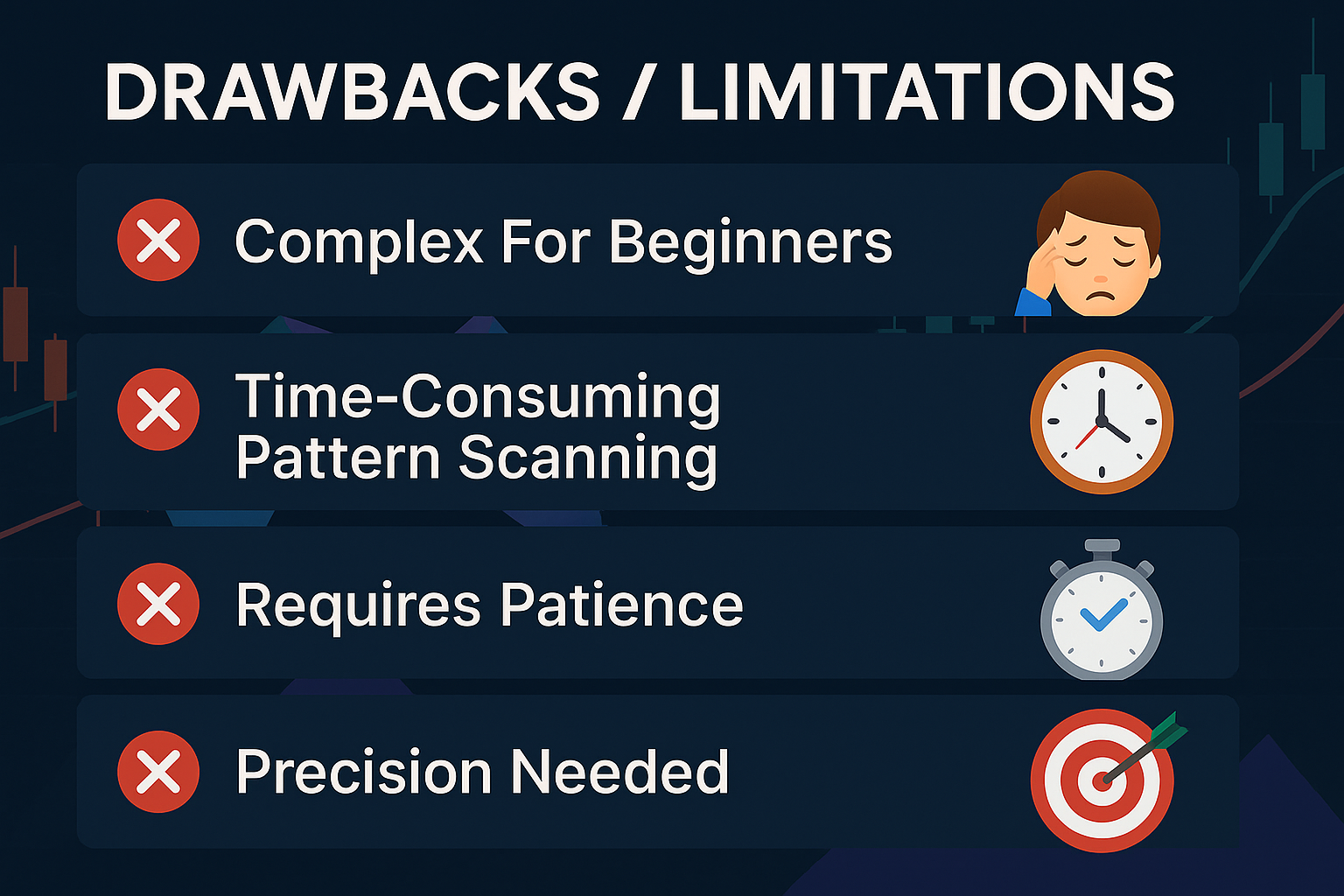
❌ Complex For Beginners
Harmonics aren’t “plug-and-play.” You need to train your eyes like a chart sniper in the mountains — spotting structure, ratios, and patterns with discipline. Beginners expecting shortcuts quickly learn: this is art + math, not luck.
❌ Time-Consuming Pattern Scanning
Finding clean harmonic patterns can feel like treasure hunting. Sometimes you scan charts like a detective chasing clues — waiting for the perfect geometric setup. Manual work pays — but yes, it’s not for the lazy trader.
❌ Requires Patience
Markets don’t form harmonic masterpieces every hour. These setups take time, and impulsive traders get bored fast. Harmonics reward those who wait — like a lion stalking the perfect moment to strike.
❌ Precision Needed
Harmonics are not “close enough” strategies — they’re mathematical choreography. A tiny ratio mistake, and the whole pattern collapses. It demands precision like a surgeon, not a gambler.
✅ Common Mistakes Beginners Make
❌ Forcing Patterns That Don’t Exist
Some traders start seeing Gartleys in coffee foam and Bats in clouds. That’s not analysis — that’s pattern hallucination mode. Harmonics demand discipline, not imagination — if the ratios aren’t real, the pattern isn’t either.
❌ Ignoring Exact Fibonacci Rules
Harmonics are not “close enough” strategies — they’re math or nothing. Miss a ratio by a mile? The market will remind you why precision matters. Respect the fibs, or the fibs will humble you.
❌ Entering Before Pattern Completion
Jumping in before point D forms is like running on a stage before your cue. Patience here isn’t optional — it’s your profit engine. Let the pattern finish, then strike with sniper timing.
❌ No Stop-Loss Discipline
Even the cleanest harmonic zone can break — markets love surprises. Skipping stops is like walking into battle without armor. Protect capital first, profit comes next — professional mindset only.
❌ Not Combining With Confluence
Yes, harmonics are powerful — but even wizards use shields. Support/resistance, structure, volume, RSI — they strengthen your edge. Confluence turns good setups into high-probability precision strikes.
✅ FAQs: Harmonic Strategy for Beginners
Q: Are harmonic patterns a reliable trading strategy?
A: When applied with discipline, proper risk management, and in conjunction with other analysis tools, they can be highly reliable. Their success rate depends on strict adherence to the rules.
Q: Do I need special software to trade harmonic patterns?
A: While possible to draw them manually, automated charting software that identifies and draws patterns is highly recommended to ensure accuracy and save time.
Q: What is the most successful harmonic pattern?
A: The “Crab” pattern is often cited as having one of the highest success rates due to its extreme extension and tendency to mark significant market tops and bottoms.
Q: How do I learn to identify these patterns quickly?
A: Practice is key. Start by manually identifying patterns on historical charts, then use software to verify your findings. Consistent screen time will build your pattern recognition skills.
✅ Final Thoughts
Harmonic trading blends science, precision, and psychology. It isn’t random guessing — it’s geometry, Fibonacci math, and disciplined chart reading. It demands patience and accuracy, but rewards mastery with high-quality reversal entries and powerful risk-reward trades.
If you want to trade like a strategist — not a gambler — harmonic patterns give you a structured edge. Learn them step-by-step, practice on charts, use confluence, and never skip stop-loss rules. The market speaks through structure — harmonics help you listen.
Trade with logic. Respect Fibonacci levels. Let patterns complete.
Master harmonic patterns, and you master one of the most mathematically powerful systems in forex trading.
Sources



No Comments