
- Home
- Forex Tutorial
- Grid vs Martingale in Forex: S ...

✅ Introduction
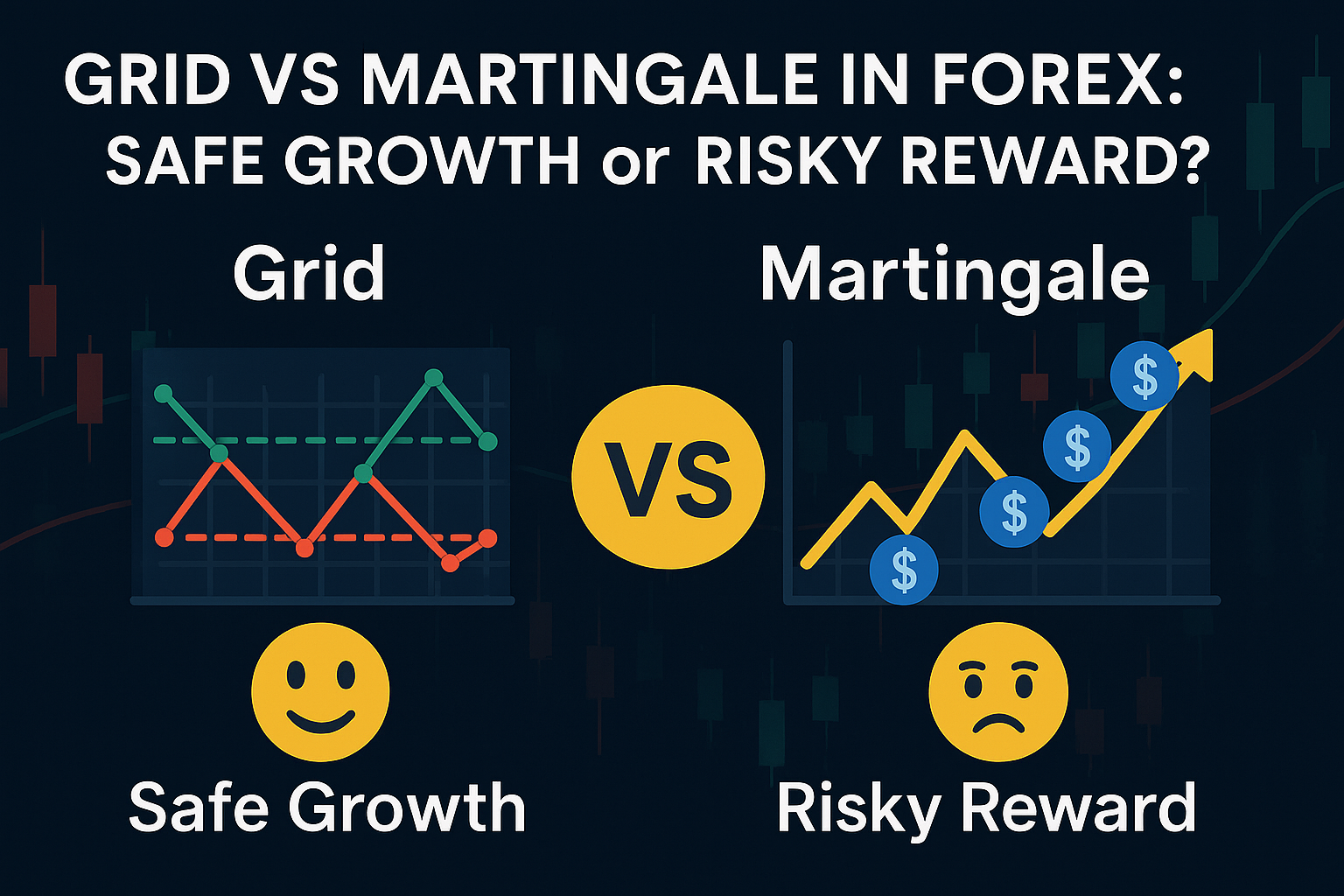
Ever seen traders stack orders like a chess grandmaster laying traps on the board — or double positions like a gambler refusing to lose? That’s the world of Grid trading and Martingale trading in forex. Two opposite philosophies. Two powerful results. Two different risk profiles.
Both Grid vs Martingale strategies aim to profit from market movement — yet one focuses on systematic grid spacing and range trading, while the other presses hard on position size to recover losses. Understanding this difference matters, because learning when and how to use these methods can be the difference between stable returns… or rapid account ruin.
In this blog, we will explore:
- Simple definitions of Grid & Martingale strategies
- How each strategy works with examples
- Types of grid & martingale systems
- Benefits and risks
- When to use grid vs martingale
- Common mistakes beginners make
- FAQs and practical insights
- Final thoughts for safe, smart trading
This guide is built for forex learners, price-action students, EA users, and risk-management beginners.
✅ Simple Explanation
Grid Trading involves placing a network of buy and sell orders at predetermined intervals above and below the current market price. It capitalizes on price fluctuations within a defined range, making small, repeated profits from market oscillations rather than predicting the market’s overall direction. The core idea is to buy when the price drops to a grid level and sell when it rises to another.
The Martingale Strategy, originating from 18th-century gambling, is a position-sizing technique where a trader doubles their position size after every losing trade. The theory is that one subsequent winning trade will recover all previous losses and generate a profit equal to the initial bet. In trading, it’s a high-risk, high-reward approach that banks on the idea that the market will eventually reverse or mean-revert.
It assumes
Eventually, price will return and one win will recover everything.
It can work — until price trends too far in one direction, wiping accounts.
✅ How They Work (With Simple Examples)
📊 Grid Strategy Example
Price = 1.2000
You place grid orders every 20 pips:
| Order | Type | Price |
|---|---|---|
| 1 | Buy | 1.1980 |
| 2 | Buy | 1.1960 |
| 3 | Buy | 1.1940 |
When price retraces upward, each buy position closes in profit. No doubling. No guessing trend. Just capturing swings.
🎰 Martingale Strategy Example
Start trade = 0.01 lot
Loses → next trade doubles to 0.02 lot
Loses again → 0.04 lot
Loses again → 0.08 lot
When one winning trade hits, all losses are recovered + a small profit.
BUT if price trends too long — margin call.
✅ Types of Strategies
Grid Trading Types
- Static Grid: Uses fixed price intervals, regardless of market volatility.
- Dynamic Grid: Adjusts grid spacing automatically based on market volatility, often using indicators like Average True Range (ATR) or Bollinger Bands.
- Martingale Grid: A variation that combines grid trading with the Martingale principle, increasing the lot size of subsequent grid orders as the price moves against the initial entry.
- Anti-Martingale Grid: Increases lot sizes after winning trades to capitalize on momentum, and reduces size after losses to control risk.
Martingale Strategy Types
- Classic Martingale: The simple and most risky version, doubling the lot size after every loss.
- Modified Martingale: Uses a lower multiplier (e.g., 1.5x) or caps the number of doubling steps to mitigate risk.
- Anti-Martingale (Reverse Martingale): The opposite approach, where traders increase their position size after a winning trade to compound gains and reduce it after a loss to protect capital.
✅ Benefits of Grid vs Martingale
✅ Grid Strategy Benefits
- Works in Range-Bound Markets: Perfect for sideways or choppy markets where price action is contained within a specific range.
- Emotion-Free Automation: Can be fully automated using trading bots or Expert Advisors (EAs), eliminating emotional decision-making.
- Consistent Profit Potential: Generates a consistent stream of small, repeated profits as the price fluctuates within the grid.
- No Trend Prediction Required: Profits from volatility, whether the market moves up, down, or sideways, removing the need to predict market direction accurately.
✅ Martingale Benefits
- High Potential Profit: Can generate significant profits quickly if a winning streak occurs, especially with a low win rate but high risk.
- Recovers Losses: Theoretically, a single win can erase a series of losses, which is highly appealing to traders focused on recovering drawdowns.
- Capitalizes on Mean Reversion: The strategy is built on the principle of mean reversion, where prices tend to revert to their average over time.
✅ Drawbacks & Risks Grid vs Martingale

❌ Grid Drawbacks
- High Capital Requirement: Can tie up a significant amount of capital, as many buy and sell orders are open simultaneously.
- Vulnerable to Strong Trends: A strong, one-directional trend that moves beyond the grid’s range can lead to substantial losses and margin calls.
- Risk of Overexposure: With multiple trades open, a trader can become overexposed to the market, especially if the price moves against the grid.
- Requires Regular Management: Even automated grids require monitoring and adjustment to adapt to changing market conditions.
- Unlimited Risk: The core flaw is the assumption of unlimited capital. A long losing streak will inevitably lead to exponential position sizing, wiping out an entire trading account.
- High Psychological Pressure: The increasing risk and mounting losses can create immense psychological pressure, leading to poor decision-making.
- Misleading Risk-to-Reward Ratio: Each successive trade has an exponentially higher risk for the same initial profit amount.
- Gambling Mentality: Promotes a gambling-like mindset, prioritizing recovery over sound risk management and analysis.
✅ When to Use Each Strategy
✅ Best Conditions for Grid
Grid trading thrives when the market is moving sideways like it’s on a treadmill — not trending, just wandering back and forth. High-liquidity times give smooth price action, and pairs like EURUSD or USDCHF behave politely enough for grids to work without drama.
With moderate capital and calm volatility, the grid sits quietly, harvesting tiny profits like a patient fisherman catching waves of price movement.
✅ Best Conditions for Martingale
Martingale only survives in markets that move in tiny, predictable ranges, where price wiggles instead of runs. You need serious backup capital — like going into battle wearing full armor — because one wrong streak will try to finish your account.
Used carefully in short-term scalping, with iron-clad stop rules, martingale can recover losses fast… but only if you treat it like a bomb with a timer.
✅ Common Mistakes
⚠️ Grid Strategy Mistakes
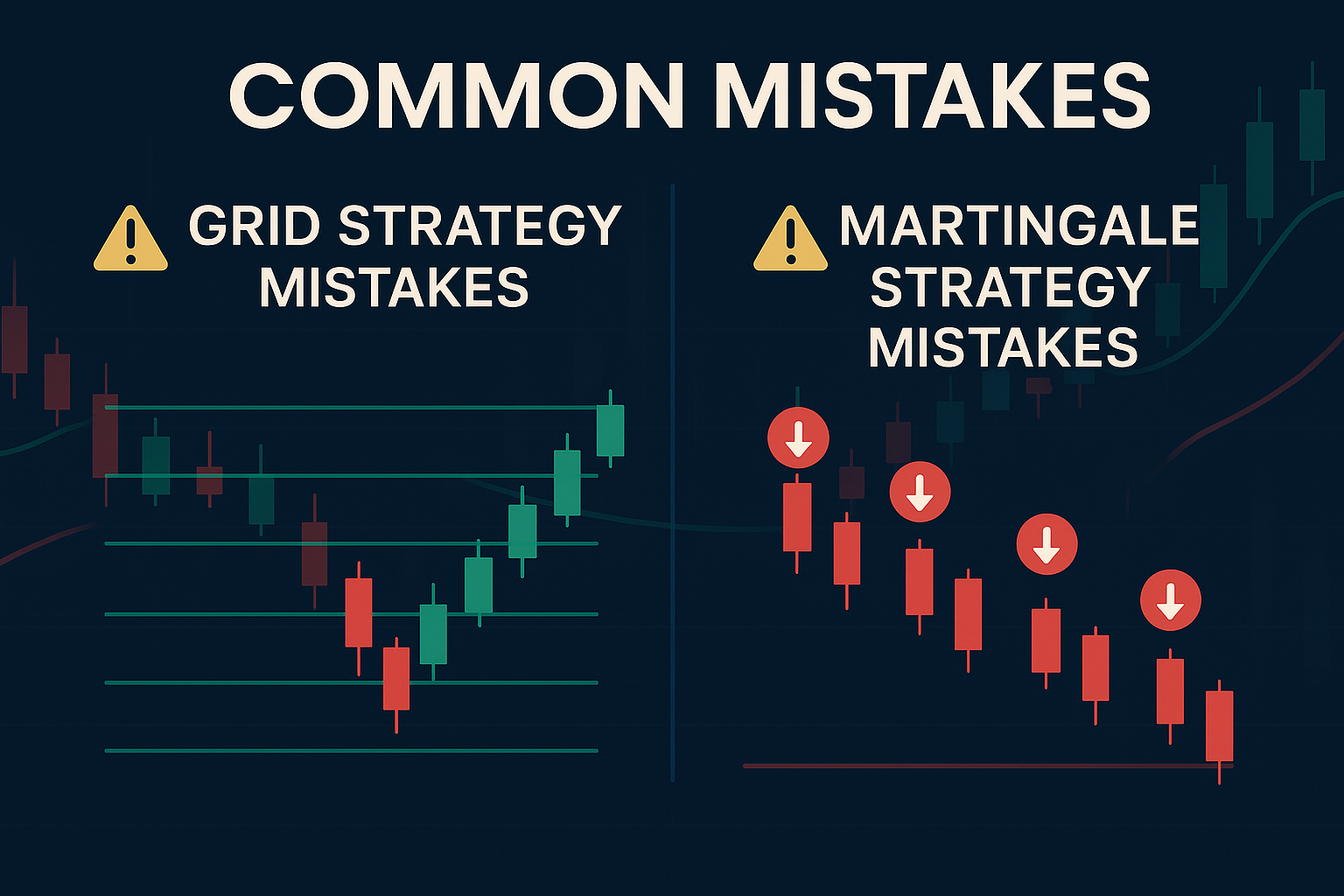
Running a grid without a stop-loss is like driving downhill without brakes — it feels smooth… until it doesn’t. Placing grid levels too tight turns your chart into a machine-gun of orders, draining margin faster than you can blink. Using grid during high-impact news like NFP or CPI? That’s the trading equivalent of skydiving without checking your parachute.
And trying it on wild pairs like Gold or GBPJPY without filters is like juggling chainsaws blindfolded — sooner or later, something gets cut.
⚠️ Martingale Strategy Mistakes
Doubling endlessly with no limit is not strategy — it’s financial Russian roulette. Skipping an equity stop-loss means you’re willingly handing your account to the market gods. Trying martingale with tiny capital is like bringing a water pistol to a fire fight — it won’t save you. Increasing lot size emotionally? That’s panic gambling dressed as trading.
And believing “the market must reverse”? Markets don’t owe you a pullback — sometimes they march one direction for weeks, and martingale punishes every minute of it.
✅ Grid vs Martingale Comparison Table
| Feature | Grid | Martingale |
|---|---|---|
| Trend Prediction | Not required | Not required |
| Risk Level | Moderate | Extremely high |
| Profit Style | Slow, steady | Sudden recovery wins |
| Lot Size Rule | Fixed / progressive | Always doubles losses |
| Best Market | Ranging | Small-range only |
| Emotions | More control | High stress |
| Account Size Needed | Medium | Large (safe use) |
✅ Using EAs in Grid vs Martingale Trading
Grid + EA
Grid trading works well with EAs because the strategy requires consistent execution, fixed spacing, and emotion-free order placement.
The EA automatically places buy/sell orders as price moves across grid levels, manages take-profits, and controls trade volume. This removes manual stress and helps avoid impulsive decisions.
Martingale + EA
Martingale EAs are popular but can be high-risk account killers if not managed correctly.
The EA doubles the lot size after each loss, aiming to recover drawdowns quickly — but this requires large capital, strict limits, and tight risk rules.
✅ FAQs Section
1. Which is safer — Grid vs Martingale ?
Grid is the less dangerous cousin — when spacing and lot sizes are controlled, it behaves like a disciplined soldier. Martingale? That’s the wild daredevil who jumps off cliffs and hopes wings appear.
2. Can beginners use grid trading?
Yes — if they treat it with respect, use proper spacing, and always add a stop-loss. Grid rewards patience and planning — not button-smashing.
3. Can martingale ever be safe?
Only with steel-solid rules, max-loss limits, and deep pockets. Even then, “safe” and “martingale” in the same sentence feels like comedy.
4. Best currency pairs for grid?
Pairs that move like civilized adults, not caffeinated toddlers:
✅ EURUSD
✅ USDCHF
✅ AUDUSD
Avoid hyperactive assets like GOLD or GBPJPY unless you’re a chart samurai with experience.
5. Does martingale require emotional control?
Oh yes — iron-mind, zen-monk, ice-veins level control. If emotions run the show, martingale will break your account and your confidence. Not a beginner playground.
✅ Final Thoughts

The decision between Grid Trading and Martingale depends heavily on your trading personality, risk tolerance, and capital. Grid Trading offers a structured, lower-risk approach that capitalizes on market volatility within a defined range, making it a viable strategy for automated trading in specific market conditions. The Martingale strategy, on the other hand, is an inherently dangerous and aggressive technique that, while mathematically intriguing, carries an exponential risk of total capital loss and is generally viewed as unsustainable gambling.
For learners, understanding the mechanics of both is valuable, but practicing robust risk management is paramount. Grid trading, with its transparent risk parameters, offers a more educational and manageable starting point, especially when combined with other forms of analysis to identify optimal ranges and trend changes. The perilous nature of Martingale, however, serves as a powerful lesson in the risks of unchecked aggression in the markets. Always start with disciplined capital management and test strategies rigorously in a demo environment before committing real capital.


No Comments