
- Home
- Forex Tutorial
- Breakout Trading Guide: Trade ...


✅ Introduction
Ever watched the market move sideways, building pressure like a volcano on the edge of eruption — and then suddenly BOOM! Price bursts through a level and launches like it’s breaking chains? That’s a breakout — and breakout trading is the art of catching that explosive moment.
Breakout trading matters because big market moves rarely start quietly — they begin with breakouts, and traders who recognize them early can ride momentum instead of chasing it. Breakouts are where trends are born, volatility wakes up, and powerful trading opportunities appear.
In this blog, we will explore:
- What a breakout strategy is
- How breakout trading works with live examples
- Types of breakout strategies
- Benefits and risks
- When to use breakouts
- Breakout trading mistakes to avoid
- FAQs for clarity
- Final guide for breakout traders
This guide is designed for forex beginners and learning traders, helping you understand, execute, and master breakout setups with confidence.
✅ What Is a Breakout Strategy?
A breakout strategy in forex trading is a method where traders enter the market when price breaks above a resistance level or below a support level with strong momentum.
Instead of trading inside a range, breakout traders wait patiently until price pushes beyond a key barrier — signaling a potential new trend or powerful move.
Simple meaning
When price breaks a major level and starts moving fast — traders jump in to ride the momentum.
Breakouts signal that buyers or sellers finally overpowered the other side, and fresh momentum has entered the market.
✅ How It Works (With Example)
Let’s say EUR/USD has been stuck between 1.1000 support and 1.1050 resistance for hours or days. Price keeps bouncing inside this range — like a trapped lion pacing its cage.
Finally, the price breaks above 1.1050 with a strong bullish candle and high volume.
A breakout trader would:
- Enter BUY as soon as price closes above resistance
- Place Stop-Loss below the breakout zone or last swing low
- Set Take-Profit based on the next resistance level or R:R target (1:2 or 1:3)
Price explodes upward — you catch the move early — and ride the wave.
Breakouts work because they represent fresh sentiment, strong orders, and market commitment.
✅ Types of Breakout Strategies
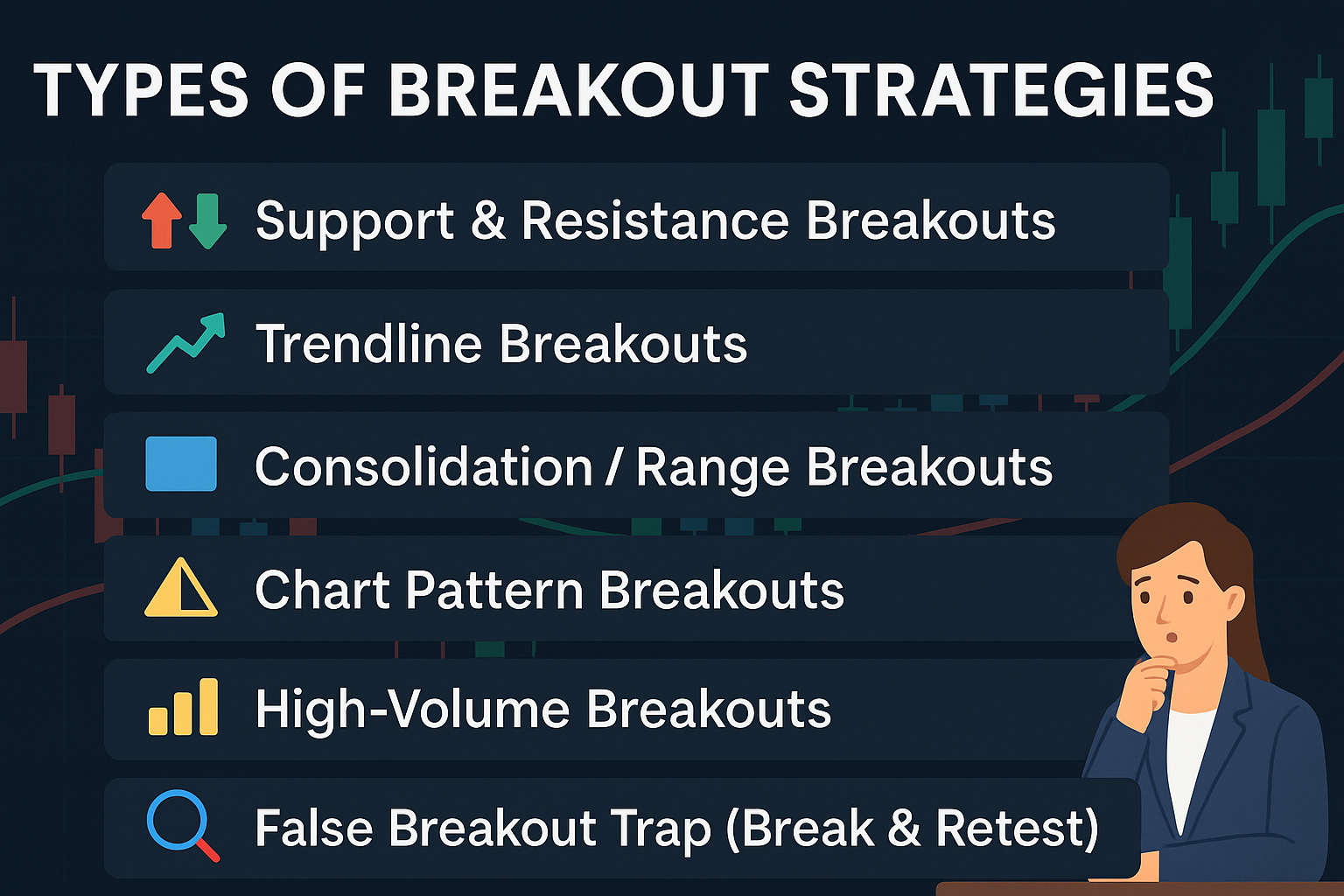
Breakouts come in different forms depending on market behavior. Here are the most common:
1️⃣ Support & Resistance Breakouts
Support and resistance breakouts are the royalty of breakout trading. Price has been banging its head against resistance or refusing to fall below support like a stubborn warrior defending a castle wall — until BOOM! It finally punches through. When price breaks above resistance, it’s like it kicked the door down and screamed, “I’m going higher whether you like it or not!” Break below support? Same story — except the floor collapses, gravity takes over, and price free-falls like it forgot parachutes existed. Clean, powerful, unmistakable — this is breakout trading at its finest.
2️⃣ Trendline Breakouts
Trendline breakouts are the dramatic turning points — the market saying, “That trend? Yeah, we’re done with it.” Price has been respecting a trendline over and over, like it’s following strict traffic laws — until suddenly it swerves, smashes the line, and tells everyone the old trend is over. When a trendline breaks, momentum surges, traders wake up, and charts light up like fireworks. It’s the market changing gears with attitude.
3️⃣ Consolidation / Range Breakouts
Range breakouts are where boredom transforms into chaos. Price sits trapped in a tiny box, moving sideways like it’s half asleep — then out of nowhere, it EXPLODES out of the range like a lion released from a cage. One moment: silence and yawns. Next moment: candles flying, spreads widening, traders screaming “LET’S GO!” These breakouts often move fast and furious — blink, and you’re either profitable or crying.
4️⃣ Chart Pattern Breakouts
Chart pattern breakouts are the Hollywood drama of trading. Triangles, flags, head and shoulders — these formations build suspense like a Netflix thriller. Price tightens, squeezes, coils — the calm before the storm — until the breakout erupts and unleashes raw momentum. Whether it’s a flag promising continuation or a head & shoulders hinting reversal, these setups explode with power once price escapes the pattern’s grip. Patterns don’t just break — they detonate.
5️⃣ High-Volume Breakouts
High-volume breakouts are market fireworks — price doesn’t just move, it charges forward with an army behind it. When volume blasts up, breakout traders know the market means business.
This isn’t a gentle push — it’s a barricade-breaking stampede.
6️⃣ False Breakout Trap (Break & Retest)
False breakouts are the market trolling impatient traders — a fake push, then a slap.
Price tempts, traps, then snaps back, wiping early entries. Smart traders wait for the retest, letting price prove it’s serious before striking.
✅ Benefits of Breakout Strategy
Catch Big Moves Early
Breakouts let you jump on huge market moves right as they ignite. When price bursts out of a zone, trends can explode — and you’re already riding the wave. This is the sweet spot where smart traders enter before the crowd wakes up.
Clear Entry & Exit Rules
No guessing, no drama — levels tell you when to act. You see the break, you plan the stop, you ride the move. Simple structure = clean decisions and calm execution.
High Momentum Trades
Breakouts bring speed, power, and adrenaline. Price can move fast, profits can stack faster — if you’re ready. Perfect for traders who love precision and explosive motion.
Works on All Timeframes
Scalpers, day traders, swing traders — everyone eats here. Whether it’s a 1-minute chart or a weekly chart, breakouts play everywhere. Same logic, different speed — universal and versatile.
Pure Market Logic
No messy indicator jungle. No lag. Just price breaking levels, order flow shifting, momentum taking over. Breakouts are raw, clean market truth — structure leading the way.
✅ Drawbacks / Limitations
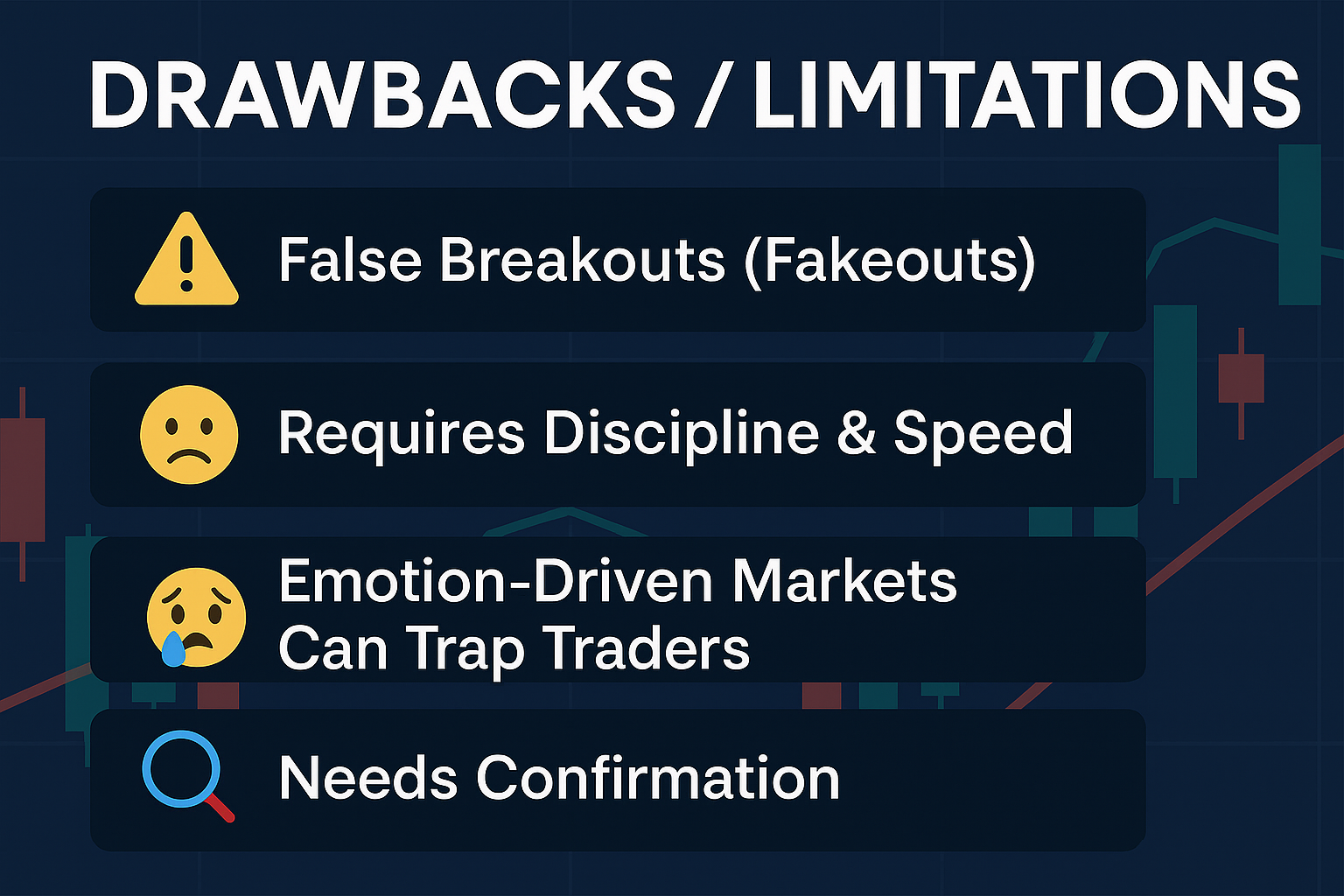
❌ False Breakouts (Fakeouts)
Sometimes the market fakes a breakout like a master illusionist, then snaps back and laughs at early traders. One second you’re celebrating — the next you’re staring at a reversal wondering what just happened. Fakeouts are the ultimate trap for the impatient.
❌ Requires Discipline & Speed
Breakout trading is not for slow clickers or indecisive minds. You must act fast, place orders cleanly, and commit — hesitation gets punished. In breakout trading, speed + discipline = survival.
❌ Emotion-Driven Markets Can Trap Traders
News drops, volatility spikes, and suddenly price behaves like a wild animal escaping a zoo. Breakouts can fail violently when emotion takes over. If you’re not prepared, the market will whip you out before you blink.
❌ Needs Confirmation
Jumping in without confirmation is like diving into a pool without checking the water. Patience protects profits — wait for proof, not hope. In breakouts, confirmation turns chaos into confidence.
✅ When to Use Breakout Trading
✅ Best Times for Breakouts
London open — when the market wakes up swinging and volume explodes. NY session (especially the overlap) — liquidity surges and trends launch hard. Right before/after major news — energy builds, then price blasts off. When price squeezes tight in consolidation — pressure builds… then BOOM.
❌ Avoid Breakouts When
Market is crawling sideways like it’s half-asleep — no volume, no power. Right before chaotic news like NFP — unless you enjoy roller-coaster whiplash. Low liquidity, wide spreads — the market becomes a stop-loss hunting jungle. Slow markets turn breakouts into fake-outs — timing is the difference between edge and gamble.
✅ Common Mistakes Beginners Make
❌ Entering Without Confirmation
A tiny wick above resistance does not mean “full send.” Wait for a powerful candle, not a shy market poke. Breakouts reward patience — guessers get punished.
❌ Tight Stop-Loss Placement
Placing stops too close is like handing your stop-loss to the market and saying,“Please take this.” Give trades breathing room — liquidity hunts are real.
❌ Chasing Breakouts Too Late
If price has already blasted off like a rocket, don’t sprint after it. Late entries = riding fumes, not momentum. Sometimes the best trade is no trade.
❌ Ignoring Volume or Volatility
A breakout without power is a trap wearing makeup. No momentum? No trust. Volume + volatility = the fuel behind real moves.
❌ Over-trading Every Movement
Not every tiny push is a breakout — sometimes it’s just noise stretching its legs. Jumping on everything = emotional burnout. Patience turns breakouts into weapons, not chaos..
✅ FAQs About Breakout Strategy
Q1: Is breakout trading good for beginners?
Yes — as long as you don’t jump in like a cowboy at the first candle jump. With confirmation + risk management, beginners can crush it. No gambling — just smart breakout execution.
Q2: Which timeframe is best?
Scalpers: 1m – 5m (fast, furious, adrenaline-powered) Day traders: 15m – 1H (balanced and steady)
Swing traders: 4H – Daily (big moves, calm mindset) Pick the one that matches your heartbeat speed.
Q3: Best indicators for breakout confirmation?
- Volume (the engine power behind the move)
- Moving Averages (trend backbone)
- RSI / MACD (momentum proof — not vibes)
- ATR (checks volatility so you don’t panic at wicks)
Tools don’t trade for you — but they help you see the truth faster.
Q4: Do breakouts work without indicators?
Absolutely — raw price action breakouts hit hard. Pure levels + candles = clean, powerful decisions.
Indicators are seasoning, not the steak.
Q5: Can breakouts fail?
Yes — fakeouts are real and ruthless. Breakout traps love emotional traders. That’s why confirmation + stop-loss = your armor.
✅ Final Thoughts

A breakout strategy is more than a method — it’s a mindset. You wait, watch, and strike only when price breaks free and momentum takes control. Breakout traders don’t predict — they react to proof.
This approach rewards patience, observation, and discipline. Remember, the best moves often come from tight consolidation, strong momentum, and clean levels.
Master your chart, respect risk, wait for the breakout, then ride the wave with confidence. You’re not chasing candles — you’re catching market power the moment it’s unleashed.
Sources
https://en.wikipedia.org/wiki/Breakout_(technical_analysis)



No Comments