
- Home
- Forex Tutorial
- Feel the Market: Master Price ...

✅ Introduction
Ever looked at a forex chart and felt like the candles were speaking to you — telling a story hidden beneath every wick and body? That’s price action trading: the art of reading the market without clutter, complication, or lagging indicators slowing you down. And here’s why it matters — price is the truth. Indicators react to price, but price speaks first.
In this blog, we will explore everything beginners must know about price action trading in forex, including:
- What price action means in simple terms
- How price action works with real examples
- Common price action patterns and types
- Key benefits of price-based strategies
- Drawbacks every trader must understand
- When to use price action for best results
- Mistakes new traders often make
- FAQs for clarity and guidance
- Final advice to evolve into a confident price action trader
By the end, you’ll understand how to read the market’s language and trade like price is your compass.
✅ What Is Price Action?
Price action trading is a strategy that focuses on reading raw market movement — candlesticks, support and resistance, supply and demand, breakouts, and trend structure — without relying heavily on indicators.
Instead of waiting for lagging signals, price action traders interpret candlestick patterns, highs and lows, market structure, liquidity zones, and order flow behavior to decide when to enter or exit trades.
In simple words
Price action is the art of understanding what price is doing — right now — and trading directly from it.
✅ How It Works (With Example)
Imagine EUR/USD is approaching a strong support zone that price has bounced from multiple times. You notice a bullish pin bar (hammer candle) forming with a long lower wick rejecting the level.
A price action trader interprets this as buyers stepping in — demand overcoming supply.
What happens next?
- Entry: After candle confirmation above support
- Stop-loss: Below the pin-bar wick (protecting from liquidity sweep)
- Take profit: Next resistance area or based on RR plan (1:2 / 1:3)
You didn’t need an indicator to tell you — price itself revealed the story.
✅ Types of Price Action Techniques

Price action isn’t one thing — it’s a toolbox. Here are the major categories
1️⃣ Candlestick Patterns
Candlestick patterns are the emotional fingerprints of the market tiny windows into the souls of buyers and sellers. A single pin bar can scream, “The bulls fought back!” An engulfing candle can roar, “Trend shift incoming buckle up!” From dojis whispering indecision to inside bars plotting breakout ambushes, every candle becomes a battlefield story of confidence, fear, and domination.
2️⃣ Support & Resistance
Support and resistance are the invisible force fields of the market levels where price magically stops, reverses, or explodes through like a hero breaking chains. These zones aren’t lines; they are psychological battle grounds where traders defend positions like warriors guarding a kingdom. When price reaches these zones, strategies sharpen, pulse rises, and the market prepares for war.
3️⃣ Market Structure
Market structure isn’t just technical it’s the market’s life rhythm. Higher highs and higher lows march proudly like a victorious army in an uptrend. Lower highs and lower lows descend like a kingdom collapsing. And when structure breaks, it’s not just a signal it’s a plot twist worthy of a dramatic movie moment. Trend direction? It’s not guessed it’s decoded like a sacred prophecy.
4️⃣ Supply & Demand Zones
Supply and demand zones are where the mysterious giants of the financial world the institutions, the “smart money” secretly pull the strings. Price doesn’t move casually here; it launches or drops like a rocket. These zones mark the footprints of billion-dollar orders, the whispers of hedge-fund titans, and the traps set for retail traders who dare to enter unprepared.
5️⃣ Breakouts & Retests
Breakouts and retests are the market’s grand entrances explosive moments when price breaks chains and charges forward. But the real mastery comes in the retest, when the market returns like a sly fox to see if traders are paying attention. Those who wait patiently catch the move like snipers; those who rush get slapped by fake-outs and left wondering what just happened.
6️⃣ Liquidity Concepts
Liquidity is not just price movement it’s the market hunting prey. Stops are not safe havens; they are targets. Institutions don’t just move price — they lure traders in, sweep liquidity like a shark circling bait, and then launch the real move while retail traders stare in disbelief. Understanding liquidity is like seeing the matrix — once you see it, you never trade the same again.
✅ Benefits of Price Action
Raw Market Understanding
With price action, you’re not just reading charts you’re tuning into the heartbeat of the market. You don’t rely on watered-down, lagging tools you speak the market’s native language. Every move, every wick, every rejection becomes a message, and you become the trader who doesn’t react late… you anticipate with intuition sharpened by raw truth.
Works in All Markets
Price action is the universal passport of trading. Forex? Yes. Crypto? Absolutely. Stocks, indices, gold, oil? It dominates there too. While other traders scramble to “adjust” strategies based on indicators and systems, price action traders walk confidently into any market like, “Price moves? I understand.” No limitations just pure adaptability.
Cleaner Charts
Forget charts that look like someone spilled rainbow spaghetti all over the screen. Price action gives you clean, elegant charts where structure shines and signals breathe. No messy indicators screaming at you — just pure clarity. It’s like going from an overcrowded, noisy office to a peaceful panoramic ocean view. Your brain will thank you.
Faster Decision Making
Indicators lag. News arrives late. Hype comes after the move. But price? Price whispers the truth first. With price action, you don’t beg for confirmation you see it unfolding live. Decisions become quick, sharp, confident not because you’re rushing, but because you’re finally synced with the market’s pulse.
Strong Trading Psychology
Studying raw price builds mental steel. You don’t panic when charts wiggle you read the story. You develop intuition, patience, discipline, and confidence that comes from seeing reality, not chasing signals like a lost tourist. Price action turns traders into calm analysts, not emotional button-clickers.
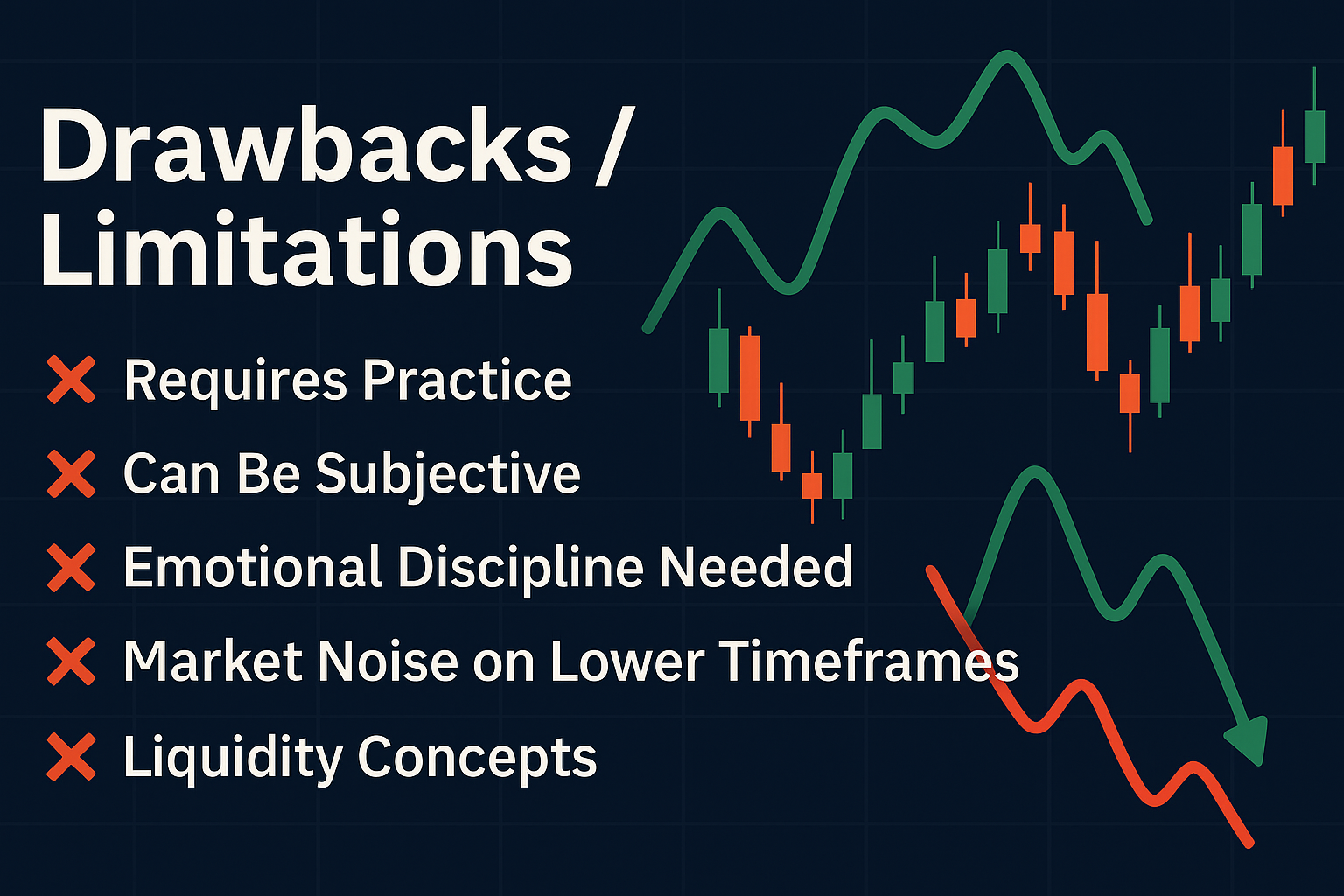
✅ Drawbacks / Limitations
❌ Requires Practice
Price action isn’t a magic button it’s a skill. You don’t wake up one morning and suddenly read candles like they’re ancient prophecy scrolls. It takes time, screen time, mistakes, “Why did I enter that?” moments, and eventually mastery. If you want shortcuts, this isn’t the strategy… this is the dojo.
❌ Can Be Subjective
Price action isn’t black-and-white it’s art blended with logic. Two traders can look at the same chart and one sees a breakout to glory while the other sees a trap from the depths of trader-hell. Interpretation matters, experience matters, and sometimes… the chart just trolls everyone.
❌ Emotional Discipline Needed
Price action will test your patience like you’re trying to stay calm in traffic without coffee. It demands emotional strength waiting for confirmation, ignoring fake moves, and not clicking because your brain whispers, “Maybe this one…” Discipline separates pros from impulse traders who chase candles like house cats chasing laser dots.
❌ Market Noise on Lower Timeframes
Lower timeframes are like hyperactive toddlers unpredictable, chaotic, and full of sudden spikes meant to steal your stop-loss and laugh. Liquidity hunts, fakeouts, random wicks the lower you go, the more the market likes to play hide-and-seek with your sanity. Only the mentally armored survive.
Even with its challenges, price action remains one of the most respected and powerful foundations in trading
✅ When to Use Price Action
Price action shines in:
- Trending markets (structure is clear)
- Key zones (support, resistance, supply, demand)
- Breakouts and retests
- High-liquidity sessions (London, New York)
- Swing trading and intraday setups
Avoid depending solely on price action when:
- Market is choppy and directionless
- Extremely low-volume sessions
- Before major news spikes (NFP, CPI, FOMC)
Right timing = higher accuracy.
✅ Common Mistakes Beginners Make
❌ Trading Every Candle Pattern
Just because a pin bar pops up doesn’t mean it’s your destiny. Candles are not magic tickets context is king. Trading every pattern you see is like trying to marry every person who smiles at you. Price action rewards patience, not impulsive pattern-collecting.
❌ Ignoring Market Structure
Seeing a bullish candle in a downtrend and buying anyway? That’s like bringing an umbrella after you’re already drenched. If structure doesn’t agree forget the signal. Trend, zones, momentum if they don’t align, the market will gladly teach you a very expensive lesson.
❌ No Stop-Loss Discipline
Price action does not mean “trust the market forever and hope.” No stop-loss = donating your account to the market gods. Even the cleanest pattern can fail, and if you don’t protect yourself, the market will happily bulldoze your confidence and your balance.
❌ Overtrading
Click-click-click does NOT equal profit-profit-profit. Overtrading is caffeine-fuelled chaos your brain thinks you’re working hard, but your account knows you’re destroying it. Quality setups build accounts, not hyperactive button-mashing.
❌ Thinking Price Action Means “No Indicators Ever”
Some traders treat indicators like forbidden fruit but the pros know a little confluence isn’t treason. A moving average, volume tool, or session indicator isn’t cheating — it’s strategy. Minimal tools + price truth = power combo.
✅ FAQs About Price Action Trading
Q1: Is price action better than indicators?
Not “better” — but more direct. Indicators lag; price is real-time truth.
Q2: Which timeframe is best?
H1, H4, and Daily work best for clean structure.
Lower timeframes = more noise.
Q3: Can beginners learn price action?
Yes — but expect practice. Start on demo, study charts daily.
Q4: Do I need indicators at all?
Optional — some use moving averages or volume for confirmation.
Q5: Can price action work in crypto and gold?
Absolutely. Price action works on any instrument driven by supply & demand.
✅ Final Thoughts
Price action trading is a powerful way to connect with the market directly — no lagging tools, no overwhelming screens, just pure price behavior guiding your decisions. It rewards patience, observation, discipline, and emotional control.
If you’re tired of flashy indicators that promise magic but deliver confusion, price action offers clarity and truth. Learn to read structure, recognize patterns, trust market logic, and most importantly — give yourself time to master it.Trading isn’t about predicting the future — it’s about understanding the present.
When you master price action, you stop guessing… and start reading the market like a fluent language.
Sources
https://en.wikipedia.org/wiki/Price_action_trading



No Comments