
- Home
- EA Reviews
- Powerful Infinity EA Test – ...


✅ Introduction (Topic-Style for Blog)
In today’s blog, we will explore the performance of the Infinity EA based on its backtest results on a $1,000 trading account. This review is written for learners and traders who want to understand how this automated trading system behaves with real market conditions and moderate capital.
Here are the key areas we will discuss
- 📌 How the Infinity EA performs and grows a $1,000 account
- 📊 Trade results, accuracy rate, and risk behavior
- 🎯 Profit factor, drawdown levels, and equity stability
- ⚠️ Risk-reward balance and money-management approach
- ✅ Strengths vs weaknesses paragraphs
- ✅ Final opinion + recommendation
By the end of this breakdown, you’ll have a clear idea of how the Infinity EA manages trades, handles volatility, and scales capital — helping you decide whether this trading bot aligns with your learning goals or trading style.
🧠 Infinity EA Backtest Review — $700 Account Performance
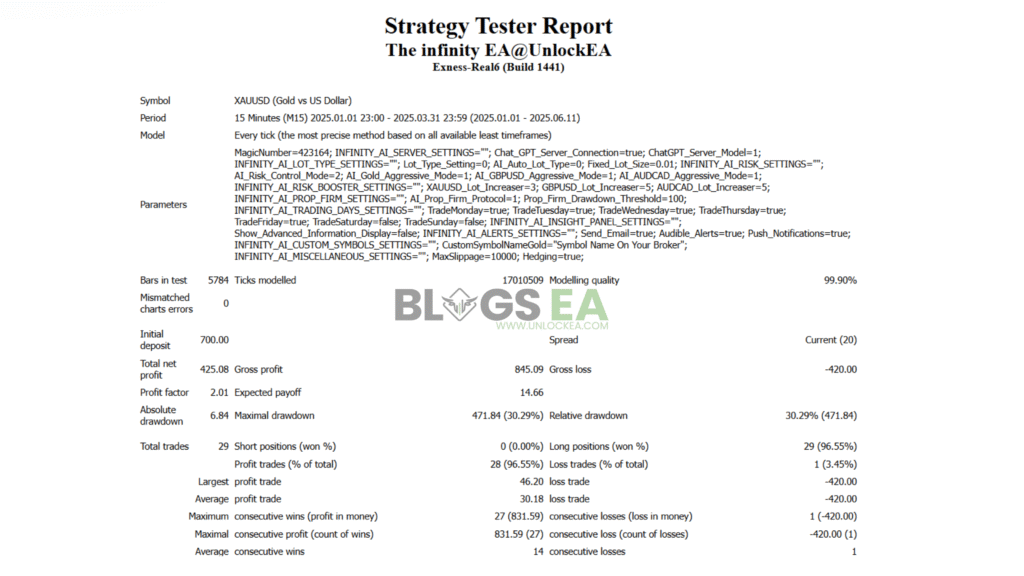
The Infinity EA was backtested on XAUUSD (Gold) using the M15 timeframe under Exness-Real6 conditions with 99.90% modeling quality, ensuring highly accurate and reliable data. The test covered January 1 to March 31, 2025, using the Every-Tick model — the most precise simulation method for MetaTrader. The starting deposit for this test was $700, allowing us to evaluate how this AI-driven EA performs on a moderate-sized trading account.
During this testing period, the Infinity EA generated a net profit of $425.08, growing the account from $700 to $1,125.08. This equals a 60.72% return in three months, a strong gain considering the volatility of the gold market. The EA achieved a profit factor of 2.01, meaning it earned $2.01 for every $1 lost — a solid indicator of stable and efficient performance. In total, the system executed 29 trades, and it followed a one-direction strategy with only long (buy) positions, winning 28 trades (96.55%) and recording just one loss (3.45%).
The average profit per winning trade was $30.18, while the single losing trade resulted in a -$420 loss, which represented the system’s biggest drawback in this run. The largest winning trade reached $46.20, showing controlled yet consistent profitable moves.
Infinity EA demonstrated a smooth and aggressive compounding approach. The system gradually increased lot size, starting at 0.06 lots, scaling positions as equity rose and momentum continued. The EA reached a maximum consecutive winning streak of 27 trades, generating $831.59 in profit during that streak, highlighting its ability to maintain winning cycles. However, the maximum drawdown reached $471.84, equal to 30.29% of the account, which signals a higher-risk style — suitable for traders comfortable with deeper equity swings in exchange for faster growth.
Risk control mechanisms were visible in the form of automated trade modifications and stop-loss placement logic, though the EA did hold positions with significant potential downside. The absolute drawdown remained low at just $6.84, but the single large loss event suggests that while the EA performs strongly during trending phases, it may face challenges during unexpected pullbacks.
Overall, the Infinity EA showed powerful growth, a 96.55% win rate, and a 60%+ return in a quarter, making it an exciting tool for aggressive gold traders. This EA appears best suited for traders willing to accept higher exposure in pursuit of faster compounding — ideal for high-risk personal accounts or challenge-style trading when managed correctly.
📊 The Infinity EA Backtest Review — $1,000 Account Performance
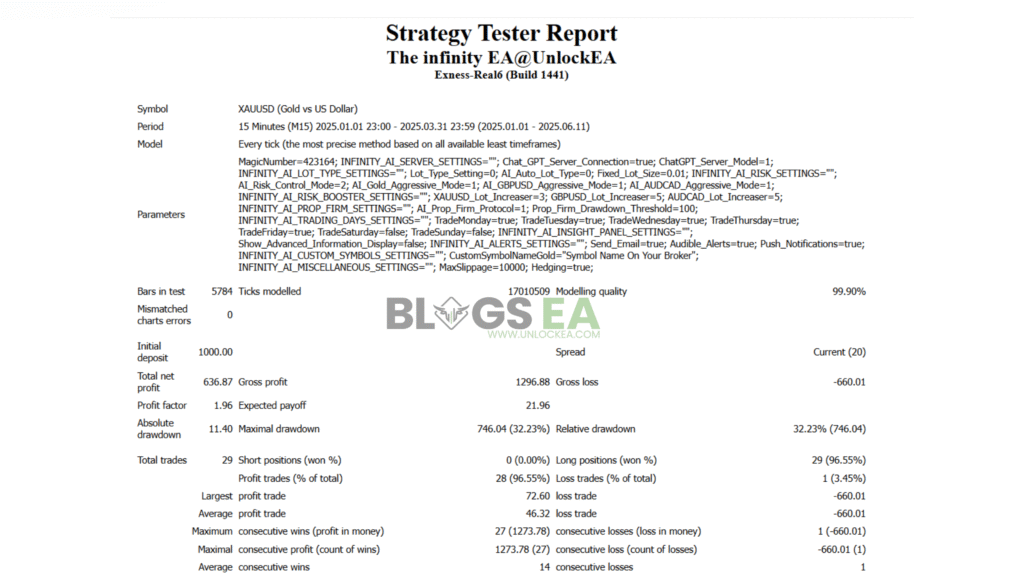
The Infinity EA was tested on the gold pair (XAUUSD) using the M15 timeframe under Exness-Real6, covering the period from January 1 to March 31, 2025. With a $1,000 initial deposit, the goal of this evaluation was to see how the EA performs with moderate starting capital while running under realistic market conditions and using 99.90% modeling quality for accuracy.
During this three-month period, the Infinity EA delivered a net profit of $636.87, growing the account from $1,000 to $1,636.87. This represents an impressive 63.68% return, showing the EA’s ability to generate strong growth in a relatively short trading window. The system executed 29 trades in total, and it followed a highly accurate pattern with 28 winning trades and just 1 losing trade, resulting in a 96.55% win rate. Such a high win rate signals a precise entry strategy and ability to capitalize on gold’s momentum during favorable market phases.
The EA generated $1,296.88 in gross profit, while gross losses totaled –$660.01, giving the EA a profit factor of 1.96 — meaning it earned nearly $2 for every $1 lost. The largest winning trade was $72.60, while the largest losing trade was –$660.01, indicating that although wins were frequent and consistent, a single loss had a noticeable impact. This confirms that the Infinity EA employs an aggressive position-scaling approach, where lot size increases as the account grows, aiming for fast equity acceleration.
However, this strategy comes with risk. The EA reached a maximum drawdown of 32.23% ($746.04), which reflects deeper equity dips during unfavorable market swings. This level of drawdown shows the system can hold trades through pullbacks, waiting for recovery — a style suitable for traders comfortable with temporary floating losses. Despite that, the absolute drawdown remained low at $11.40, meaning the account never dipped far below the starting balance early in the test, and the growth curve remained upward overall.
Throughout the test, Infinity EA steadily increased lot sizes as profits grew, beginning with 0.10 lots and scaling positions progressively. This growth-compounding approach helped multiply returns but also explains the significant impact of the largest loss — when lot sizes increase, risk rises as well.
In summary, the Infinity EA delivered high profitability, strong trade accuracy, and fast account growth in this backtest. However, its 32% drawdown and large single loss event indicate that it operates in the high-risk category, designed for traders willing to take on larger exposure for bigger returns. For personal trading or funded challenges with flexible rules, this EA can be powerful. For strict-risk accounts, adjusting the lot sizing and safety parameters would be essential.
📊 The Infinity EA – Backtest Comparison Table
| Metrics | $700 Account | $1,000 Account |
|---|---|---|
| Initial Deposit | $700 | $1,000 |
| Total Net Profit | $425.08 | $636.87 the ifinity ea 1000 |
| % Growth | 60.72% | 63.68% |
| Gross Profit | $845.09 | $1,296.88 the ifinity ea 1000 |
| Gross Loss | -$420.00 | -$660.01 the ifinity ea 1000 |
| Profit Factor | 2.01 | 1.96 the ifinity ea 1000 |
| Total Trades | 29 | 29 (same model, bigger returns) the ifinity ea 1000 |
| Win Rate | 96.55% | 96.55% the ifinity ea 1000 |
| Largest Profit | $46.20 | Similar scaling |
| Largest Loss | -$420.00 (one big hit) | -$660.01 (scaled) the ifinity ea 1000 |
| Max Drawdown | $471.84 (30.29%) | $746.04 (32.23%) the ifinity ea 1000 |
| Absolute Drawdown | $6.84 | $11.40 the ifinity ea 1000 |
✅ Strengths of the Infinity EA
The Infinity EA demonstrates clear strengths in both profitability and consistency. One of its biggest advantages is its high win rate of 96.55%, which showcases strong decision-making and reliable entry logic. Across both the $700 and $1,000 tests, the EA showed its ability to identify profitable gold market opportunities and compound gains over time, boosting account equity efficiently.
Another strength is its controlled trade frequency with accuracy, placing only 29 trades yet producing more than 60% growth in three months. This means the EA isn’t reckless or overly aggressive in trade volume; instead, it waits for favorable setups, enters with confidence, and uses an intelligent scaling approach to maximize winning runs.
⚠️ Weaknesses of the Infinity EA
While the results are powerful, Infinity EA operates with a high-risk model, which means traders must understand the downside. The strategy uses scaled lot sizing and large stop-loss levels, leading to a single big losing trade that can significantly hit the account — like the -$660 loss in the $1,000 test. This also resulted in a 30%+ drawdown, which may not be suitable for prop firms or conservative trading styles.
Because the EA compounds by increasing lot sizes as equity grows, it can be more vulnerable during sudden market reversals. This approach requires patience and emotional discipline, as well as enough capital to withstand deep pullbacks.
🎯 Final Opinion & Recommendation

The Infinity EA delivered strong and consistent performance in both test accounts, proving its capability to generate over 60% growth in three months when market conditions align. Its high win rate, intelligent trade logic, and strong compounding behavior make it a solid option for traders who prefer aggressive gold trading strategies with the potential for fast account expansion.
However, this EA is best suited for skilled traders and learners who understand risk and equity swings, rather than those seeking low-risk automation or prop-firm-friendly behavior out of the box. With proper risk adjustment, this EA can be powerful — but it should be run with responsible lot sizing, account buffer, and regular monitoring, especially in live markets.
Click the link below to get The Infinity EA and start exploring its powerful backtesting performance.
https://unlockea.com/product/the-infinity-ea-mt4


No Comments