
- Home
- Forex Tutorial
- Survive & Thrive in Forex: ...

✅ Introduction
Forex risk management refers to the process of protecting your trading capital by applying structured plans, rules, and safety tools while trading. It focuses on preventing large financial losses rather than chasing fast profits, ensuring your account survives market volatility. By setting clear risk limits, using proper trade management techniques, and controlling emotional decisions, traders build consistency and discipline. Effective risk management is the foundation of long-term forex success, helping traders stay in the game long enough to grow steadily and confidently.
It includes
- Choosing the right lot size
- Setting stop-loss & take-profit levels
- Controlling leverage
- Limiting risk per trade (1%–2% rule)
- Avoiding emotional decisions
- Managing drawdown
In short:
Forex is not just about winning trades — it’s about protecting your account.
⚙️ How Forex Risk Management Works (with Practical Example)
Imagine you have a $1,000 trading account.
✅ Smart Trader
- Risks only 2% per trade → $20
- Uses correct lot size calculation
- Has stop-loss set at 30 pips
- Pip value = $0.10 (micro lot)
Lot Size Formula:
Risk ÷ (SL pips × pip value) = lot size
$20 ÷ (30 × $0.10) = 0.066 → 0.07 lots
If trade loses → only $20 loss
Account still safe ✅
❌ Beginner Trader
- Risks 20% per trade → $200!
- No proper stop-loss
- Uses emotional lot size
Lose 5 trades → Account blown
Conclusion:
Small, controlled risk keeps you in the game.
Big risk blows your account fast.
🧠 Why Risk Management Matters in Forex
Because even profitable strategies lose sometimes.
Without risk control, one bad move = account destroyed.
Think like a pilot:
Good pilots don’t just fly fast — they fly safe.
Same in forex
Successful traders manage risk first, profit second.
🧰 Types of Risk Management in Forex
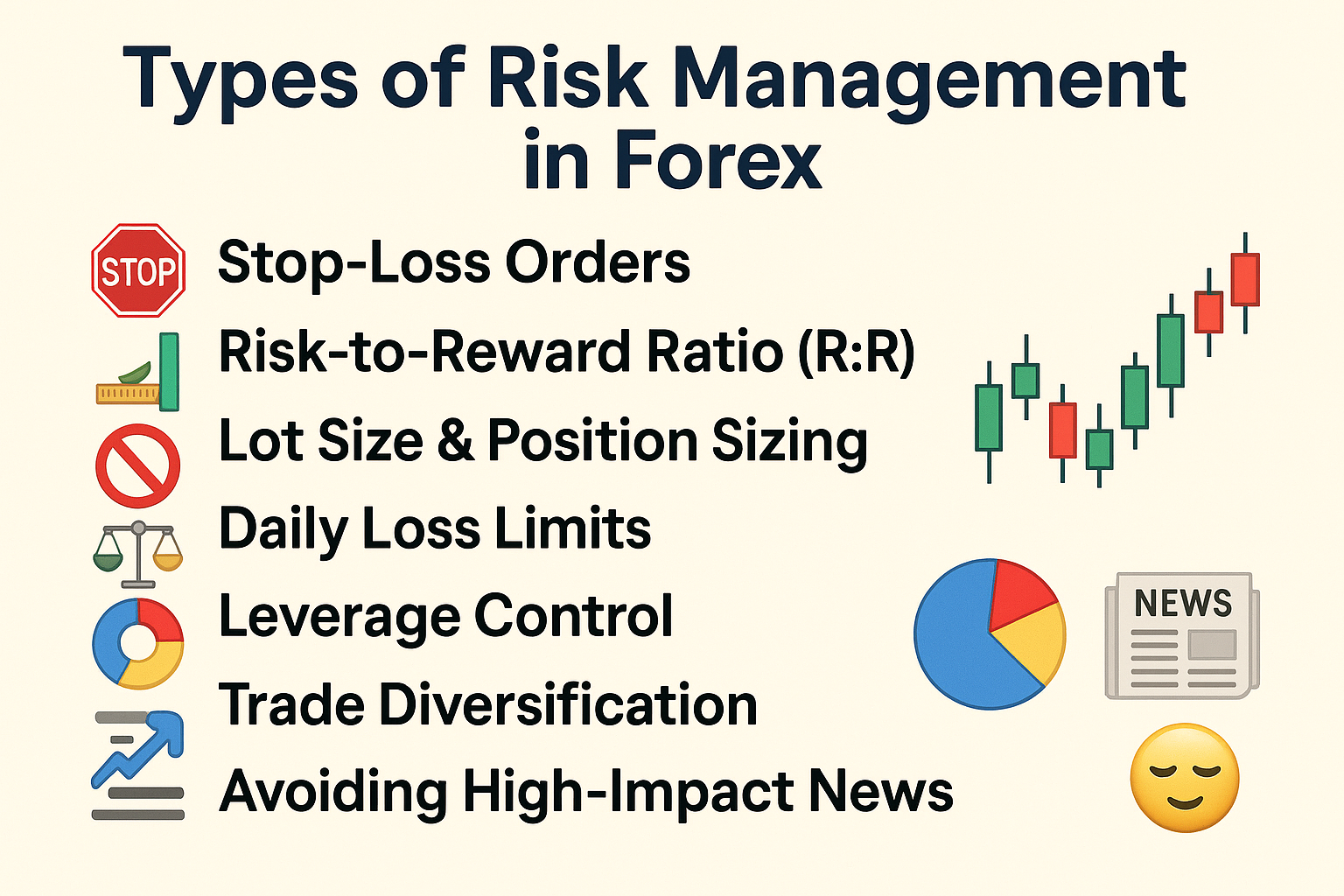
Stop-Loss Orders
A stop-loss order protects a trader from unexpected market reversals by closing a trade automatically at a set loss level. Even the strongest analysis can fail due to sudden news or liquidity spikes, so relying on hope is dangerous. Using a stop-loss builds discipline and prevents emotional decision-making during volatile moves. Think of it like a seatbelt — most of the time you may not need it, but the moment you don’t have it, consequences can be severe.
Risk-to-Reward Ratio (R:R)
The risk-to-reward ratio measures how much profit you target compared to the risk taken, typically 1:2 or 1:3. This ratio ensures long-term profitability even when not every trade wins. Traders aiming for higher reward multiples can stay profitable with fewer winning trades. It shifts trading from guesswork to probability-based decision-making, building stability and confidence.
Lot Size & Position Sizing
Lot size determines how much money a trader gains or loses per pip, so calculating it carefully is critical. Risking only 1%–2% of account balance protects your capital during losing streaks. Large lot sizes create emotional pressure and often lead to impulsive trades and fast losses. Choosing the correct lot size allows you to trade calmly, consistently, and sustainably.
Daily Loss Limits
Daily loss limits, such as stopping trading after 3%–5% loss, protect traders from emotional decisions. When frustration builds after consecutive losses, judgment becomes clouded and mistakes multiply. Taking a break after hitting daily loss limits keeps both your capital and mindset safe. Markets will always give new opportunities; discipline ensures you can take them with a clear mind.
Leverage Control
Leverage magnifies both potential profits and losses, making it a powerful but dangerous tool. New traders often blow accounts by using extremely high leverage like 1:500. Professional traders prefer controlled leverage such as 1:20 to 1:100 to maintain stability. Using leverage wisely ensures long-term survival instead of fast, emotional trading.
Trade Diversification
Diversifying trades helps avoid heavy exposure to one currency or direction, reducing total risk. For example, trading EUR/USD and GBP/USD together doubles USD exposure and increases vulnerability. True diversification means selecting trades that are not highly correlated and don’t move together. This approach spreads risk and keeps your strategy focused and balanced.
Avoiding High-Impact News
Major economic news like NFP, CPI, or FOMC can move the market violently, hitting stop-losses instantly. Price often spikes in both directions before choosing a final trend, creating unpredictable risk. Avoiding trade entries right before key news releases prevents unnecessary losses and stress. Experienced traders either wait for price to stabilize or use specific news-based strategies.
Trading Psychology Control
Trading psychology influences every decision, making emotional control essential for success. Fear, greed, and revenge-trading can turn winning strategies into losing ones quickly. Staying calm, following rules, and accepting losses as part of the process builds mental strength. The strongest traders win not only by market knowledge, but by controlling their emotions.
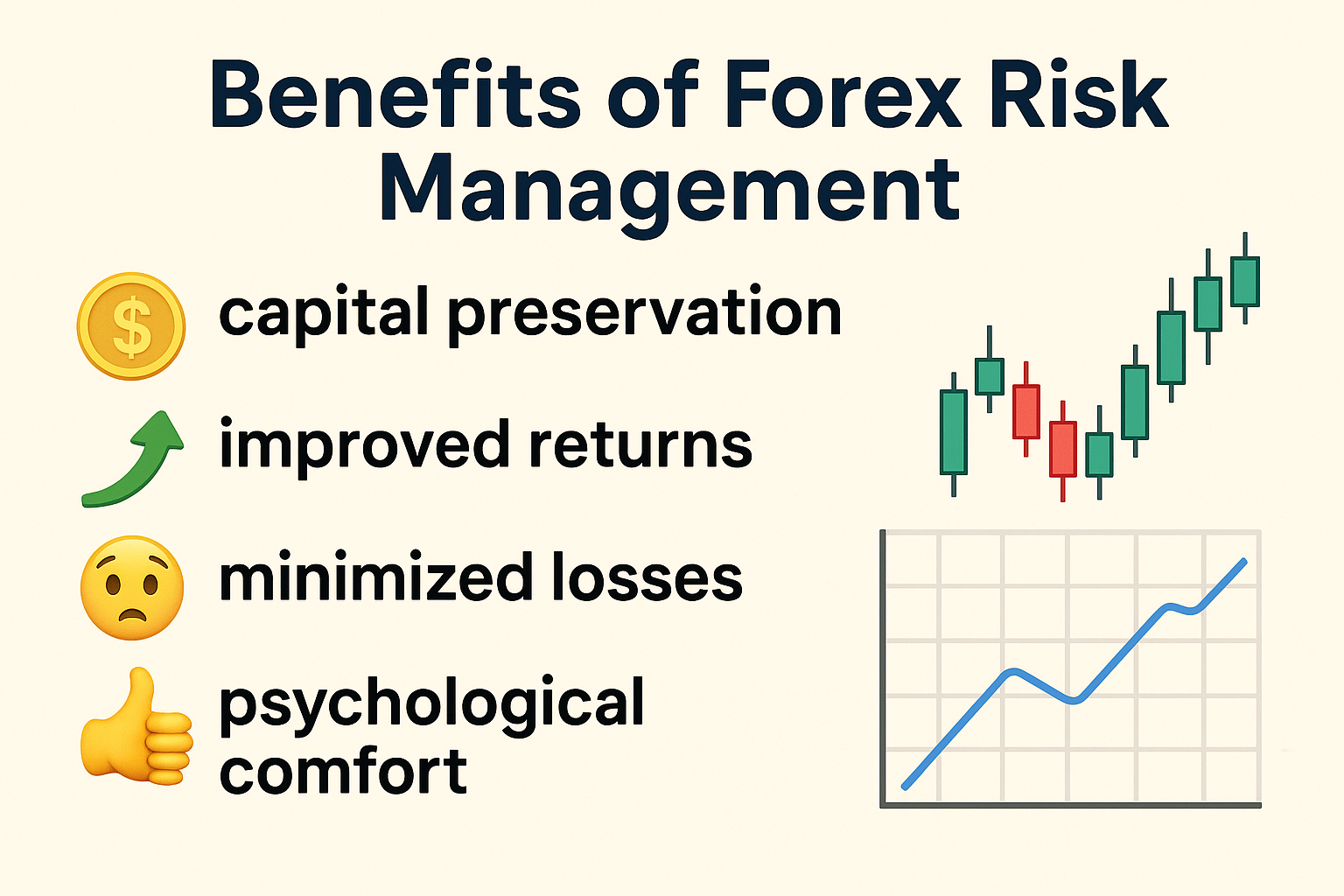
🎯 Benefits of Forex Risk Management
| Benefit | Why It’s Important |
|---|---|
| Protects capital | You survive losing streaks |
| Consistent growth | Small wins compound over time |
| Psychological comfort | Less stress, less panic |
| Better decision making | Logic instead of fear or greed |
| Boosts confidence | You trade like a professional |
| Passes prop-firm rules | Most failures are due to poor risk control |
Risk management isn’t boring — it’s your power shield in forex.
⚠️ Drawbacks / Limitations
Slower Gains
Risk management focuses on steady growth, not fast profits. It may feel slow, but it ensures long-term survival and consistent improvement instead of risky quick wins.
Requires Discipline
You must follow rules strictly — no impulsive trades or emotional shortcuts. Success comes from consistency, not excitement.
Not Foolproof
Even with strong risk management, you will still face losing trades. The goal isn’t to avoid losses — it’s to control them.
Must Learn Formulas
You need to understand basic calculations like lot size, risk percentage, and risk-to-reward ratios. It takes time, practice, and patience to apply these correctly.
But remember:
Slow, steady gains beat fast emotional losses.
🕐 When Should You Use Risk Management in Forex?
High Volatility Pairs (Gold, GBP, JPY)
Gold (XAUUSD), GBP, and JPY pairs move very fast and aggressively. Their price can jump 50–200 pips within minutes. Without proper risk management, these sharp moves can blow small accounts quickly. That’s why traders must use smaller lot sizes, tight risk rules, and wider stop-loss logic when trading volatile instruments.
Before Major News (NFP, CPI, FOMC)
Major economic announcements create unpredictable movements. The market can spike up and down rapidly before choosing a final direction. Trading during these moments without risk control can result in slippage, spread widening, and instant stop-loss hits. Smart traders either reduce their risk or wait until the market calms down.
Small Account Trading
Small accounts (like $50, $100, or $500) are at higher risk because even small losses affect them more. Over-leveraging or oversized lots can wipe them out quickly. Proper lot sizing and strict stop-loss rules are crucial to grow small accounts safely instead of gambling with them.
Scaling Up Lot Size
As your capital grows, so does your responsibility. Using bigger lots increases both profit and risk. With larger funds, even small percentage losses equal bigger dollar losses. Traders must tighten discipline, avoid emotional decisions, and stick to risk percentages when increasing lot sizes.
Passing or Managing Prop Firm Accounts
Prop firms have strict rules — especially daily and maximum drawdown limits. Breaking these rules, even with one emotional trade, results in failing the challenge or losing the funded account. Risk management becomes your qualification tool — it’s not just about making profit, but protecting the capital and following professional rules.
Risk management isn’t optional — it’s your survival tool.
🤖 Use of EAs in Forex Risk Management
Expert Advisors (EAs) play a powerful role in Forex risk management by applying trading rules automatically and removing emotional decision-making. A well-configured EA can calculate lot size, set stop-loss and take-profit levels, protect against excessive drawdown, and stop trading during volatile market conditions — all without hesitation or fear.
This automation helps traders avoid common mistakes like revenge trading, over-leveraging, and ignoring stop-losses. It is especially useful for funded account trading, where strict drawdown rules must be followed.
However, EAs are not magic tools. They must be properly configured and monitored. The best approach is using EAs as support tools, while traders still understand market behavior and risk principles. When used correctly, EAs bring discipline, consistency, and protection to your trading journey.
❌ Common Mistakes Beginners Make
| Mistake | Result |
|---|---|
| Using large lot sizes | Quick account blow-up |
| Trading without stop-loss | Hope-based gambling |
| Revenge trading | Emotional losses |
| Over-leveraging (1:500) | Massive drawdowns |
| Risking 10–30% per trade | Unrealistic greed |
| Copy trading without understanding | Blind losses |
| Trading too many pairs | Confusion + over-risk |
Don’t trade to prove you’re right — trade to protect capital.
❓ FAQs — Forex Risk Management for Beginners
How much should I risk per trade?
You should risk only 1%–2% of your total account balance per trade. This helps protect your capital and prevents large drawdowns, allowing you to stay in the market long enough to grow consistently instead of blowing your account from a few bad trades.
Do I always need a stop-loss?
Yes, always.
A stop-loss is like a seatbelt in a car — you may not need it every time, but when you do, it can save your account. Stop-losses protect you from unexpected market spikes and emotional decisions that can lead to big losses.
What is the best leverage for beginners?
For beginners, the safest leverage range is 1:20 to 1:100.
High leverage may look attractive, but it increases risk dramatically. Lower leverage gives you more control and reduces the chance of blowing your account quickly.
What is the ideal Risk-to-Reward Ratio (R:R)?
Aim for a minimum of 1:2, and ideally 1:3.
This means if you’re risking $10, you should be targeting $20 to $30 in potential profit. A good R:R helps you stay profitable even if you don’t win every trade.
Can risk management make me profitable?
Yes — absolutely.
Long-term forex success is built on discipline, capital protection, and consistent execution, not luck or random market predictions. Risk management is the backbone of profitable trading.
🌟 Final Thoughts
Forex trading is not a get-rich-quick method; it is a long-term skill that requires patience, discipline, and consistent learning. The traders who succeed are not those who chase every opportunity or trade aggressively hoping for fast profits. Instead, they focus on protecting their capital, managing risk carefully, and following solid trading rules. Small, controlled risks allow traders to stay in the market longer, and the longer you stay in the game, the more experience and knowledge you gain. Over time, this combination of learning and discipline leads to consistency and long-term profitability.
Every successful trader you see today once started as a beginner, making mistakes, learning the market, and building confidence step by step. Remember, luck does not create profitable traders — patience, risk management, and practice do. Stay focused, respect your risk rules, and trade with a clear mind. Your journey toward consistent success truly begins when you make protecting your capital your top priority.



No Comments