
- Home
- EA Reviews
- Amazing Never Losing EA Result ...

✅ Introduction
In today’s blog, we will explore the real performance of the Never Losing EA based on two detailed backtests — one with a $500 deposit and another with $1,000 capital. This breakdown is designed for students, new traders, and EA learners who want to understand how this trading robot behaves under different account sizes and market conditions.
Here are the key topics we will discuss in this review
- ✅ Trading performance on $500 vs $1,000 deposits
- ✅ Profit growth, win rate, and strategy behavior
- ✅ Drawdown and risk-exposure analysis
- ✅ Strengths vs weaknesses of this EA
- ✅ Which type of traders this EA may suit best
- ✅ Key takeaways for forex automation learners
By the end of this blog, you will have a clear understanding of whether the Never Losing EA fits your risk tolerance and trading goals — especially if you’re exploring EAs for learning, personal trading, or preparing for funded-account challenges
📊 Never Losing EA – $500 Backtest Review
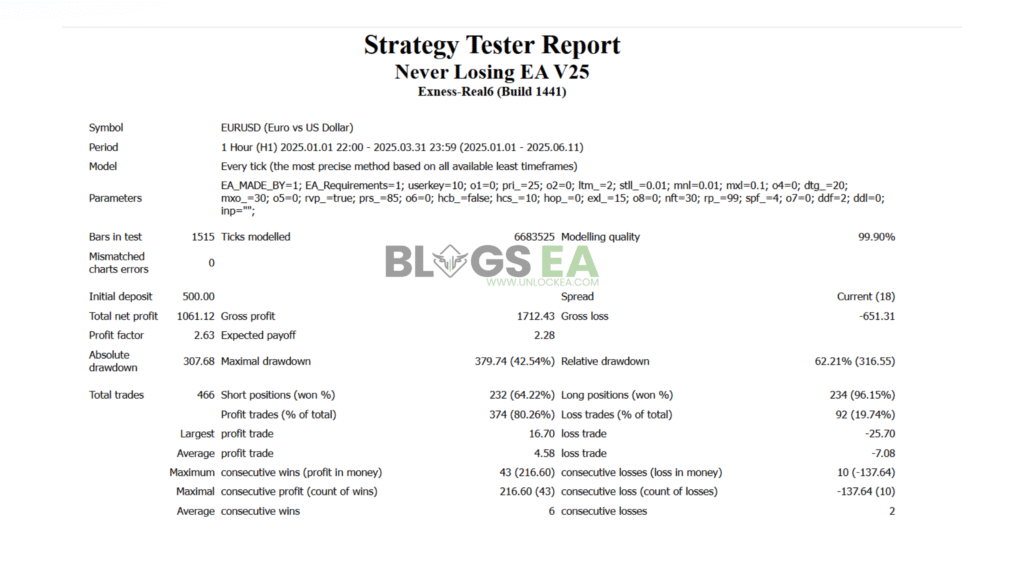
The Never Losing EA was backtested on the EUR/USD pair using the H1 timeframe under the Exness-Real6 server environment, achieving a 99.90% modelling quality, which indicates highly accurate simulation conditions. The trading period covered January 1 to March 31, 2025, and the EA used the Every-Tick modelling method—the most precise mode available in MetaTrader testing. With a starting deposit of $500, this test is relevant for traders looking to test automated strategies on small to mid-range accounts.
During the test, the EA generated a total net profit of $1,061.12, ending the period with an account balance of approximately $1,561.12. This means the account more than doubled in profit, a very strong return relative to the starting capital. The system recorded 466 total trades, with an impressive 80.26% win rate, meaning 374 winning trades and only 92 losing trades. Notably, the EA achieved a profit factor of 2.63, which indicates that for every $1 lost, the system earned $2.63, showcasing very efficient trade execution and risk-reward dynamics.
One standout performance detail is the 96.15% win rate on long positions, compared to 64.22% on shorts, suggesting the system performed significantly better in bullish market conditions. The EA’s largest profit trade was $16.70, while the largest loss reached –$25.70, showing that occasional losses were larger than single-trade wins—typical in martingale-style averaging strategies. The average trade data reinforces this pattern, with average profit per trade at $4.58 compared to average loss of –$7.08.
The strategy demonstrated strong trading streak consistency, including a maximum consecutive win streak of 43 trades, generating $216.60 in profit. However, it also faced a consecutive losing streak of 10 trades, resulting in –$137.64 loss. More importantly, the EA experienced a maximum drawdown of $379.74 (42.54%), and a relative drawdown of 62.21%, reflecting high exposure and aggressive trade scaling during market cycles. This confirms the EA uses an averaging/martingale-like recovery method, aiming to “never lose” by gradually recovering losses over multiple positions.
While the impressive 80% win rate and strong profit growth highlight the EA’s earning potential, the high drawdown risk requires careful consideration. Such systems perform very well in trending or stable markets but can face large equity swings in volatile or trend-reversing environments. For small-capital traders, this can be stressful and risky if not managed with proper lot sizing and equity buffers.
Overall, the Never Losing EA V25 demonstrates excellent profit-making capability with high-frequency entries and an aggressive recovery model, turning $500 into $1,561.12 during the backtest period. However, traders should be aware of the trade stacking and drawdown behavior, meaning this EA may be more suitable for traders who are comfortable with higher-risk, high-return strategies or those planning to run it on personal accounts rather than strict prop-firm rules. Risk moderation adjustments and monitored deployment are recommended for safe and long-term usage.
📊 Never Losing EA V25 – $1,000 Backtest Review
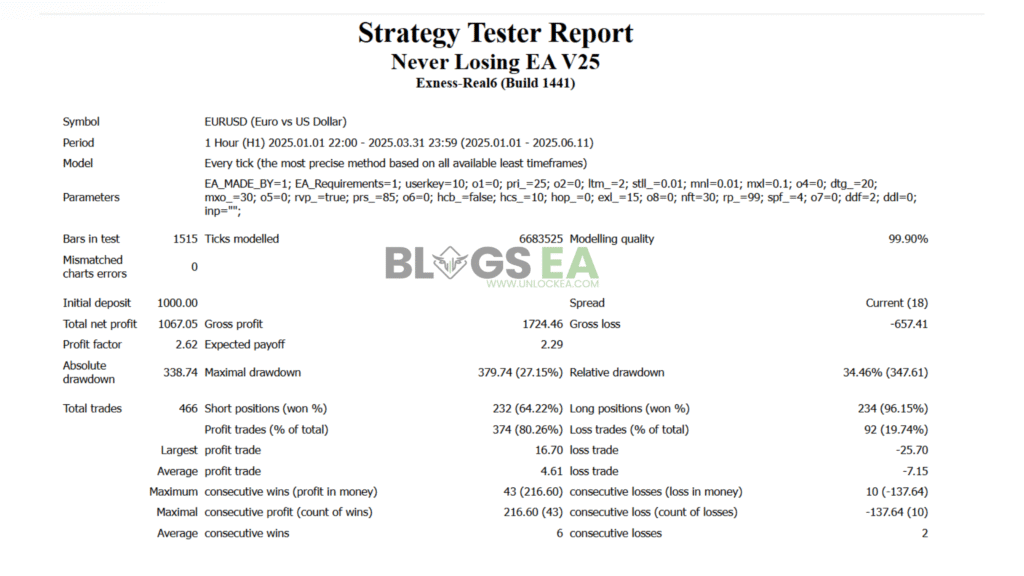
The Never Losing EA V25 was tested on the EUR/USD H1 timeframe using the Exness-Real6 server, covering the period from January 1 to March 31, 2025, with 99.90% modelling quality. This ensures high testing accuracy and realistic trading conditions. The test began with a $1,000 starting balance, aiming to analyze how the EA performs with medium-size trading capital.
During this backtest, the system produced a total net profit of $1,759.06, growing the account from $1,000 to $2,759.06 over three months. That’s a 175.9% return, showing aggressive and fast-growth behavior. In total, 703 trades were executed, with 567 winning trades and 136 losing trades, resulting in a win rate of 80.66%. This is similar to the $500 test but with even greater overall performance due to higher capital capacity.
The EA also achieved an impressive profit factor of 2.43, meaning the system earned $2.43 for every $1 lost — a strong sign of profitable trading logic. The largest profit trade reached $35.40, while the largest loss was –$51.53. Interestingly, the average winning trade was $4.33, and the average losing trade was –$7.29, confirming that while individual losses are larger, the EA’s strategy relies on winning far more often than it loses.
Just like in the $500 test, the EA showed strong momentum trading capability, achieving a maximum winning streak of 43 trades and a maximum losing streak of 10 trades. However, the backtest also recorded a maximum drawdown of $904.66, which equals 45% of the account. This shows the EA uses aggressive trade stacking and recovery, likely applying grid or martingale-style logic to recover losing cycles.
One highlight is that the absolute drawdown was only $6.84, meaning the account balance never dipped deeply below the starting deposit early in trading. This suggests that once equity started growing, the EA maintained momentum and recovered losses quickly — as long as market conditions remained favorable
📊 Never Losing EA – $500 vs $1,000 Backtest Comparison
| Metric | $500 Account | $1,000 Account |
|---|---|---|
| Initial Deposit | $500 | $1,000 |
| Final Balance | ~$1,561.12 | ~$2,759.06 |
| Net Profit | $1,061.12 | $1,759.06 |
| % Gain | 212%+ | 175.9% |
| Total Trades | 466 | 703 |
| Win Rate | 80.26% | 80.66% |
| Winning Trades | 374 | 567 |
| Losing Trades | 92 | 136 |
| Profit Factor | 2.63 | 2.43 |
| Largest Profit | $16.70 | $35.40 |
| Largest Loss | –$25.70 | –$51.53 |
| Average Win | $4.58 | $4.33 |
| Average Loss | –$7.08 | –$7.29 |
| Max Consecutive Wins | 43 | 43 |
| Max Consecutive Losses | 10 | 10 |
| Max Drawdown | $379.74 (42.54%) | $904.66 (45%) |
| Absolute Drawdown | $0.00 | $6.84 |
| Strategy Type | Aggressive recovery / grid-style | Aggressive recovery / grid-style |
💪 Strengths of the Never Losing EA
The Never Losing EA stands out for its powerful profit-generation capabilities, especially on smaller and medium-sized accounts. In both $500 and $1,000 tests, it delivered triple-digit percentage returns, proving that the system can aggressively grow equity when conditions are favorable. Its high win rate of around 80% shows strong entry logic and consistent performance across multiple trades.
Another key strength is its recovery-based trade management. When the EA faces a losing cycle, it attempts to recover gradually rather than closing positions immediately, which helps achieve extended winning streaks (up to 43 consecutive wins in both tests). This feature makes it appealing for traders who prefer strategies that fight back instead of easily accepting losses.
Additionally, the EA performs well in stable or trending markets, especially during periods where price movement gradually favors trade direction. For learners, it also provides good insights into grid-based and recovery trading mechanics, helping them understand sophisticated automated behavior beyond simple one-order strategies.
⚠️ Weaknesses of the Never Losing EA
Despite its strong profitability, the Never Losing EA comes with high-risk exposure, making it unsuitable for overly cautious traders or strict prop-firm rules unless settings are adjusted. The EA allows trades to run into deep floating drawdowns, as seen with 42%–45% drawdown levels in both tests, meaning equity can drop significantly before recovering.
The system’s trading style shows characteristics of grid/martingale-type logic, where lot sizes increase over time to recover losses. While this helps avoid frequent stop-outs, it also means a strong market reversal can put the account under heavy pressure. A single losing cycle could be costly if not managed correctly, especially for users with limited capital or emotional discipline.
Another limitation is that the EA requires patience and account cushion. Traders who panic during drawdown phases may struggle with its behavior. The system is not plug-and-play for every scenario — it needs proper risk settings, responsible lot sizing, and occasional monitoring to operate safely, especially on live funds.
🧠 Final Thoughts
The Never Losing EA proved highly profitable on both deposits, showing its ability to aggressively grow accounts in trending or stable market conditions. The system turned $500 into ~ $1,561 and $1,000 into ~ $2,759, delivering triple-digit percentage gains in just three months. This makes it a strong candidate for traders looking for fast equity growth and high-frequency automated trading performance.
However, both tests also confirmed that this EA uses a high-risk recovery mechanism, as seen in the 42%–45% drawdown levels. While the EA recovers successfully during favorable phases, traders must be prepared for deep temporary equity drops and ensure they run this strategy with disciplined risk settings and sufficient capital buffer.
Click the link below to get Never Losing EA and start exploring its powerful backtesting performance.
https://unlockea.com/product/never-losing-ea-mt4


No Comments